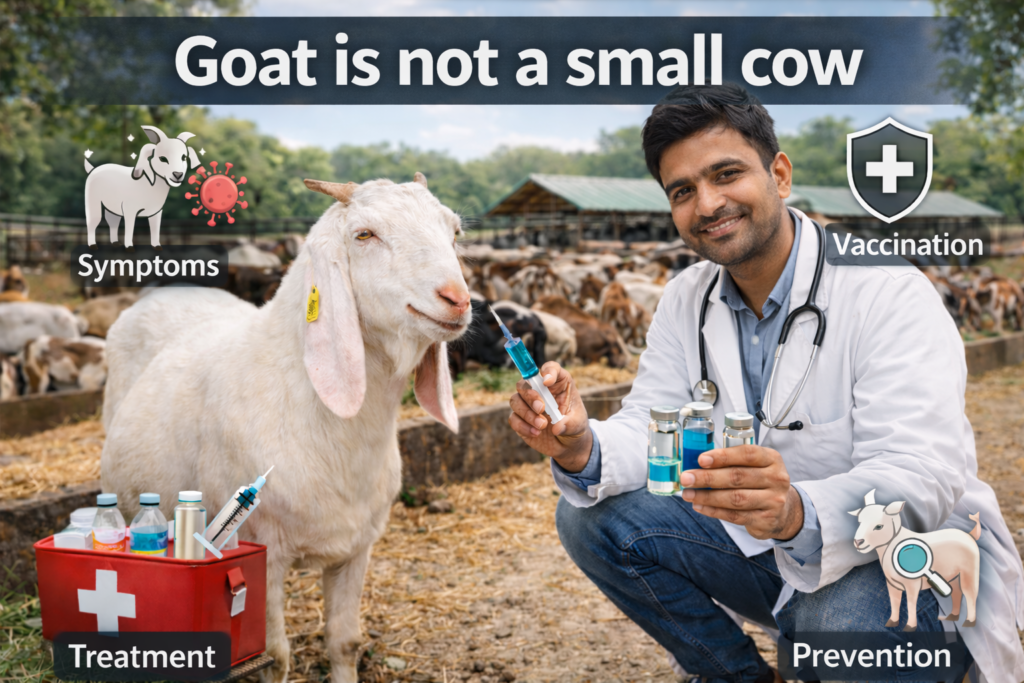
Goat Is Not a Small Cow
Why Goats Must Be Treated Differently from Cattle – A Veterinary & Biological Perspective
One of the most dangerous misconceptions in goat farming is the belief that a goat is simply a small cow. This assumption has caused countless treatment failures, drug toxicity cases, reproductive losses, and avoidable deaths in goat farms across India.
In practice, many goat diseases are treated using cattle logic — same medicines, same dosages scaled by body weight, and same management principles. From a veterinary and scientific standpoint, this approach is fundamentally flawed.
Goats are biologically, metabolically, and pharmacologically different from cattle. Treating them like miniature cows ignores decades of research in comparative physiology and veterinary pharmacology. Understanding this difference is not optional — it is critical for survival and success in goat farming.
Biological Differences Between Goats and Cattle
Although goats and cattle are both ruminants, their digestive physiology behaves very differently. Goats evolved as browsers, not grazers. Their rumen environment, feed passage rate, microbial population, and nutrient utilization are distinct.
Goats have:
- Faster metabolic rate than cattle
- Higher liver enzyme activity
- Shorter rumen retention time
- Greater sensitivity to dietary and drug changes
This means substances — nutrients, toxins, and medicines — are absorbed, metabolized, and eliminated differently in goats compared to cows.
Metabolism: The Core Reason Goats React Differently
Research has consistently shown that goats metabolize many drugs faster than cattle due to higher hepatic (liver) enzyme activity. This has two major consequences.
First, some drugs that last long enough in cows may become ineffective in goats because they are cleared too quickly. Second, some drugs that are safe in cattle may reach toxic levels in goats due to differences in absorption and distribution.
This dual risk — underdosing or toxicity — is why cattle-based treatment protocols often fail in goats.
Pharmacological Reality: Same Drug, Different Response
From a veterinary pharmacology perspective, goats are considered a separate therapeutic species, not a subcategory of cattle.
Let us look at practical examples.
Antibiotics
Certain antibiotics commonly used in cattle show reduced duration of action in goats. Goats often require different dosing intervals to maintain therapeutic levels. Using cow protocols may result in treatment failure and antimicrobial resistance.
On the other hand, some antibiotics that are relatively safe in cattle can cause severe rumen disturbance or kidney stress in goats when dose is simply “scaled down.”
Antiparasitic Drugs (Dewormers)
Goats are notorious for developing anthelmintic resistance faster than cattle. Their faster metabolism clears dewormers more rapidly, leading to sub-therapeutic exposure if cattle doses are used.
This is why goats often require species-specific deworming strategies, not cattle schedules.
NSAIDs and Painkillers
Non-steroidal anti-inflammatory drugs behave very differently in goats. Some painkillers used routinely in cattle can cause gastric irritation, kidney stress, or altered rumen motility in goats.
Incorrect dosing is a silent killer — animals may not die immediately, but productivity and immunity collapse.
Hormones and Reproductive Drugs
Reproductive physiology in goats is far more sensitive. Hormonal drugs used in cattle synchronization or fertility treatment can cause cycle disruption, poor conception, or pregnancy loss in goats if not adjusted properly.
Why Goats Crash After “Correct” Treatment
Many farmers say:
“Doctor sahab, medicine to sahi thi, phir bhi goat mar gayi.”
From a technical viewpoint, the medicine may have been correct — for a cow, not for a goat.
What usually goes wrong is:
- Wrong dose interval
- Wrong duration
- Wrong drug choice for goat metabolism
- Stress and dehydration not considered
- Concurrent nutritional imbalance
Goats under stress (transport, adaptation, disease) are even more sensitive to pharmacological errors.
Goats and Stress Physiology: A Critical Factor
Goats respond to stress much more intensely than cattle. Transport, confinement, temperature change, and social disruption trigger strong cortisol responses.
Stress alters:
- Drug absorption
- Immune response
- Gut motility
- Liver metabolism
This means that a drug that works under normal conditions may fail or cause side effects during stress phases — especially in newly established farms.
Why “Dose by Weight” Is Not Enough
A common practice is calculating medicine dose simply by body weight. Scientifically, this is incomplete.
Correct dosing in goats must consider:
- Species-specific pharmacokinetics
- Age and physiological status
- Stress level
- Feeding status
- Disease severity
Without this context, even well-intended treatment becomes risky.
The Cost of Treating Goats Like Cows
Treating goats as small cows leads to:
- Repeated treatment failures
- Rising medicine cost
- Drug resistance
- Increased mortality
- Loss of farmer confidence
Most importantly, it leads to the belief that goat farming itself is risky, when in reality the risk comes from wrong technical handling.
Why Technical Veterinary Guidance Is Essential in Goat Farming
Goat farming is not forgiving of guesswork. Because goats are metabolically fast and physiologically sensitive, trial-and-error treatment does more harm than good.
Structured veterinary guidance helps farmers:
- Choose the right drug
- Use the right dose and interval
- Support treatment with nutrition and hydration
- Prevent relapse and resistance
This is especially critical during:
- New farm setup
- Disease outbreaks
- Breeding and kidding periods
- Transport and adaptation phases
Our Approach: Goat-Specific, Not Cow-Based
In our goat-focused veterinary approach and online goat farming training, we emphasize one principle repeatedly:
A goat must be treated as a goat, not as a small cow.
This includes:
- Goat-specific disease understanding
- Species-appropriate drug protocols
- Stress-aware treatment planning
- Integration of nutrition with medicine
This technical clarity is what allows goat farms to survive the early shocks and grow sustainably.
Final Message to Goat Farmers
Goats are intelligent, sensitive, and biologically unique animals. When treated with cow logic, they suffer. When treated with goat-specific understanding, they thrive.
Successful goat farming is not about more medicines —
it is about correct medicine, correct biology, and correct guidance.
बकरी कोई छोटी गाय नहीं है – तकनीकी और पशु चिकित्सकीय दृष्टिकोण से
बकरी पालन में सबसे बड़ी और सबसे खतरनाक गलतफहमी यह है कि बकरी को गाय का छोटा रूप मान लिया जाता है। इसी सोच की वजह से ज़्यादातर बकरी फार्म में इलाज असफल होता है, दवाइयों का गलत असर पड़ता है और कई बार स्वस्थ दिखने वाली बकरियाँ अचानक मर भी जाती हैं।
हकीकत यह है कि बकरी जैविक रूप से, शरीर की कार्यप्रणाली के हिसाब से और दवाइयों के असर के मामले में गाय से बिल्कुल अलग पशु है। केवल वजन के हिसाब से गाय की दवा कम कर देना बकरी के लिए सुरक्षित इलाज नहीं माना जा सकता।
बकरी और गाय के शरीर की कार्यप्रणाली में मूल अंतर
हालाँकि बकरी और गाय दोनों जुगाली करने वाले पशु हैं, लेकिन बकरी स्वभाव से चरने वाली नहीं बल्कि ब्राउज़र होती है। इसका पाचन तंत्र, रूमेन की गति, आंतों की क्रिया और लिवर का मेटाबॉलिज़्म गाय की तुलना में कहीं ज़्यादा तेज़ होता है।
बकरी का शरीर:
- दवाइयों को तेज़ी से तोड़ता है
- तनाव में जल्दी प्रतिक्रिया करता है
- भोजन और दवा के बदलाव को कम सहन करता है
इसी वजह से बकरी में वही दवा:
- कभी कम असर करती है
- कभी ज़्यादा ज़हरीली हो जाती है
दवाइयों का असर – गाय और बकरी में क्यों अलग होता है
वैज्ञानिक शोधों के अनुसार बकरी में लिवर एंज़ाइम की गतिविधि ज़्यादा होती है। इसका मतलब है कि कई दवाइयाँ बकरी के शरीर में गाय की तुलना में जल्दी खत्म हो जाती हैं।
इसका नतीजा यह होता है कि:
- गाय में असरदार दवा बकरी में काम नहीं करती
- या फिर दवा थोड़ी ज़्यादा होते ही साइड इफेक्ट देने लगती है
खासकर:
- एंटीबायोटिक
- कृमिनाशक (dewormers)
- दर्द निवारक दवाइयाँ
- हार्मोनल दवाइयाँ
इनका उपयोग बकरी में बिना तकनीकी जानकारी के बहुत खतरनाक हो सकता है।
कृमिनाशक दवाइयों में सबसे ज़्यादा गलती
बकरी में कृमिनाशक दवाइयों के प्रति प्रतिरोध (resistance) बहुत तेज़ी से विकसित होता है। अगर गाय की तरह डोज़ या समय रखा जाए, तो:
- कीड़े पूरी तरह नहीं मरते
- दवा बेअसर हो जाती है
- बार-बार बीमारी लौट आती है
यही कारण है कि बकरी पालन में कृमिनाशक प्रबंधन गाय से बिल्कुल अलग होना चाहिए।
तनाव और इलाज की असफलता
बकरी तनाव को गाय की तुलना में बहुत ज़्यादा महसूस करती है। ट्रांसपोर्ट, बंद शेड, नया चारा, मौसम परिवर्तन — ये सब बकरी के शरीर पर गहरा असर डालते हैं।
तनाव की स्थिति में:
- दवा का अवशोषण बदल जाता है
- इम्युनिटी गिर जाती है
- इलाज का असर कम हो जाता है
इसी वजह से नई फार्म में बकरियाँ “सही दवा” देने के बाद भी नहीं बच पातीं।
सिर्फ वजन के हिसाब से डोज़ देना क्यों गलत है
कई किसान मानते हैं कि अगर गाय की दवा को वजन के अनुसार कम कर दिया जाए, तो इलाज सुरक्षित है। लेकिन यह सोच अधूरी है।
सही इलाज के लिए ज़रूरी है:
- बकरी की प्रजाति
- उम्र और शारीरिक अवस्था
- तनाव की स्थिति
- पोषण स्तर
- बीमारी की गंभीरता
इन सबको समझे बिना इलाज करना अंधेरे में तीर चलाने जैसा है।
इलाज की असफलता से किसान क्यों टूट जाता है
जब बार-बार दवा देने के बाद भी बकरी नहीं बचती, तो किसान यह मान लेता है कि:
“बकरी पालन ही नुकसान का सौदा है”
जबकि सच्चाई यह होती है कि समस्या बकरी पालन में नहीं, बल्कि तकनीकी समझ की कमी में होती है।
तकनीकी मार्गदर्शन क्यों अनिवार्य है
बकरी पालन में अनुमान और ट्रायल-एंड-एरर बहुत महंगा पड़ता है। बकरी के मामले में:
- सही दवा
- सही डोज़
- सही समय
- सही सपोर्ट (फीड, पानी, मिनरल)
इन सबका संतुलन बेहद ज़रूरी है।
इसी वजह से तकनीकी पशु चिकित्सकीय मार्गदर्शन बकरी पालन की सफलता की नींव बनता है।
📚 हमारी ट्रेनिंग में इस विषय पर विशेष ज़ोर
हमारे ऑनलाइन गोट फार्मिंग ट्रेनिंग प्रोग्राम में इस विषय को बहुत विस्तार से समझाया गया है, क्योंकि:
अगर किसान यह समझ ले कि बकरी गाय नहीं है,
तो उसका फार्म शुरुआती झटकों से बच सकता है।
सही तकनीकी समझ:
- मृत्यु दर घटाती है
- दवा खर्च कम करती है
- किसान का आत्मविश्वास लौटाती है
✅ अंतिम संदेश
बकरी को गाय समझकर इलाज करना, बकरी पालन का सबसे बड़ा जोखिम है।
जब बकरी को उसके अपने जैविक और दवाई संबंधी व्यवहार के अनुसार समझा जाता है, तभी वह स्वस्थ रहती है और फार्म मुनाफे में जाता है।
सफल बकरी पालन का मंत्र है —
“बकरी को बकरी की तरह समझो, गाय की तरह नहीं।”