
Goat Breeds in India
Foundation of Profitable Goat Farming and the Future of the Indian Goat Sector
Goat farming in India is deeply connected to breed diversity. India is home to one of the largest goat populations in the world, not because of large commercial farms, but because region-specific goat breeds have evolved to survive, reproduce and perform under local conditions. These breeds are not accidental; they are the result of decades of natural selection, farmer experience and adaptation to climate, feed availability and disease pressure.
For the Indian goat sector to grow sustainably, breed selection must be treated as a foundation, not an afterthought. Wrong breed choice leads to high mortality, poor growth, excessive feed cost and farmer frustration. Correct breed choice, on the other hand, reduces risk, stabilizes income and allows even small farmers to participate successfully in livestock-based livelihoods.
This is why goat breeds are not just animals — they are the backbone of Indian goat sector upliftment.
Why Goat Breeds Matter More Than Farmers Realize
Every goat breed differs in body size, growth rate, feed efficiency, kidding frequency and disease resistance. These differences directly affect profitability. A large-bodied breed placed in a low-input system often fails, while a medium or small indigenous breed thrives and delivers steady returns. This is the most common reason why beginners fail despite strong market demand for goat meat.
In India, goat breeds are best understood region by region, because climate, grazing pattern and feed resources change drastically across the country. Successful goat farming always aligns breed choice with local realities.
Eastern India: Low-Cost, High-Reproduction Goat Breeds
Eastern India has historically supported goat farming among small and marginal farmers. The climate is humid, fodder resources are mixed, and most farmers operate with limited capital. In this region, survival and reproduction matter more than body size.
The Black Bengal goat is the strongest example of this system. It is a small-bodied breed, but it compensates with excellent fertility, early maturity and strong disease resistance. Black Bengal goats typically achieve body weights of around 13–14 kg at one year of age, but their kidding rate is among the highest in India, often close to two kids per kidding. This makes herd expansion fast and reliable. Because of low feed requirement and high survival, Black Bengal goats consistently deliver profit to small farmers even under low-input conditions.
Similarly, local hill and Assam-type goats in the eastern and north-eastern regions are well adapted to high rainfall, hilly terrain and semi-scavenging systems. These breeds may not impress visually, but they form the economic backbone of rural households in those regions.
Northern India: Large Breeds and Breeding Value
Northern India is known for some of the most visually impressive goat breeds. These breeds are often larger, heavier and used extensively for breeding improvement programs.
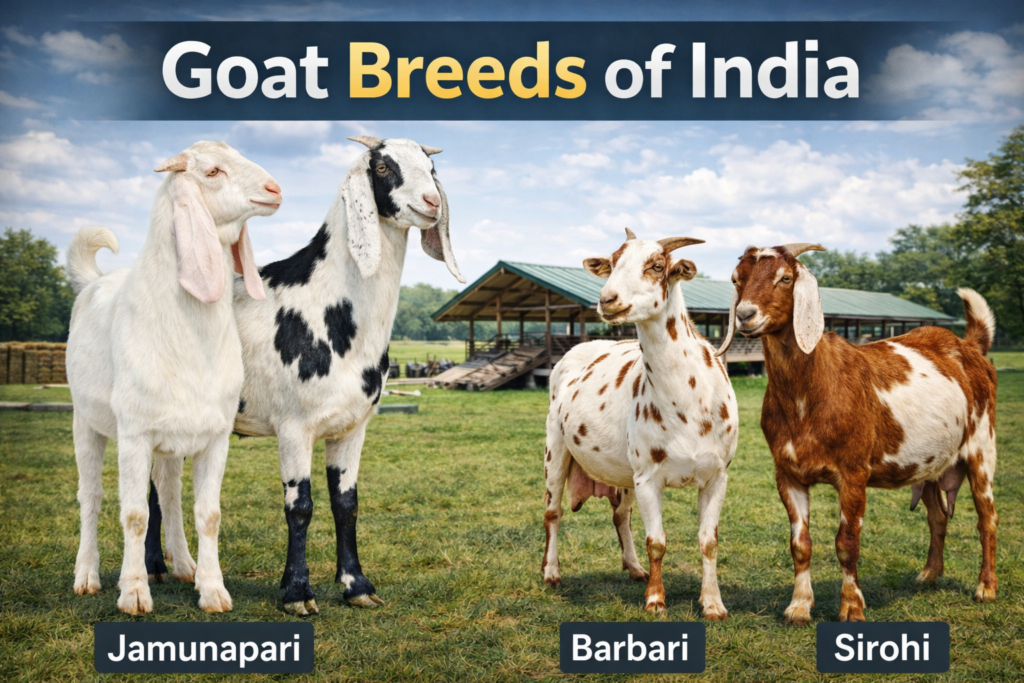
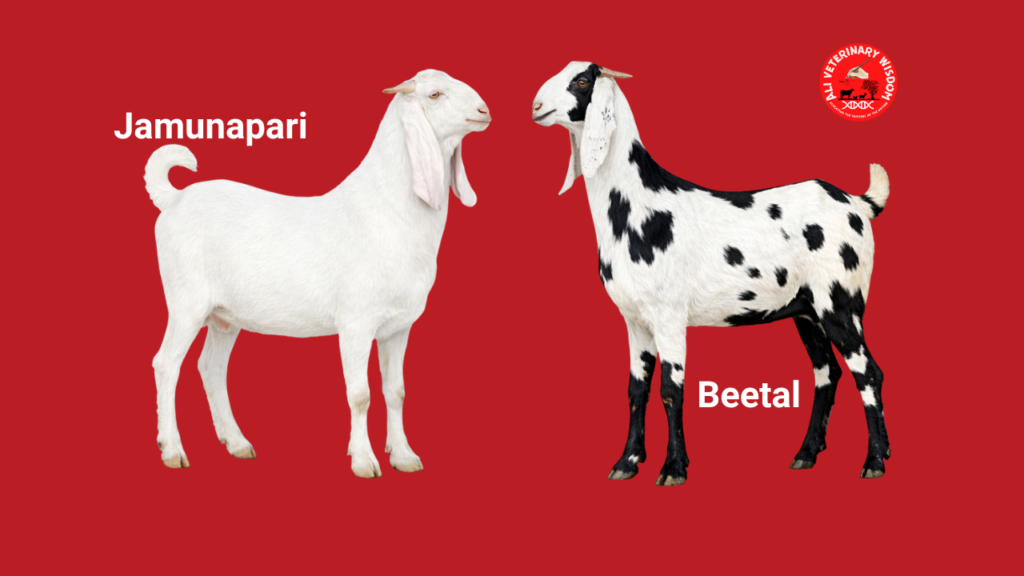
The Jamunapari goat is a classic example. It is one of the tallest and heaviest indigenous goat breeds in India, with year-old body weights commonly reaching the high twenties in kilograms. Jamunapari goats also produce moderate amounts of milk, making them suitable for dual-purpose systems. Because of their size and appearance, they command high prices in breeding markets.
However, Jamunapari goats also require better feeding and management. They are less forgiving of nutritional stress and poor housing. This is where many farmers make mistakes. Jamunapari goats are not ideal for beginners who expect high output with low input. They perform best in farms where feeding, housing and health care are planned properly. Used correctly, Jamunapari goats play a critical role in genetic improvement and structured breeding systems.
Barbari goats, also found in northern regions, represent a more balanced option. They are smaller than Jamunapari but reproduce well, grow steadily and adapt better to semi-intensive systems. Their balanced performance makes them suitable for farmers who want stability rather than extremes.
Western India: Hardy Breeds for Dry and Semi-Arid Regions
Western India presents some of the toughest conditions for livestock farming. High temperatures, low rainfall and limited fodder availability demand goat breeds that are hardy and resilient.
Sirohi goats from Rajasthan are a strong example of climate-adapted meat breeds. They have moderate body size, good survival rates and relatively low disease incidence when managed under semi-intensive systems. Sirohi goats may not grow as fast as exotic meat breeds, but their ability to perform consistently in dry regions makes them economically reliable.
Marwari goats, also from arid zones, demonstrate how indigenous breeds support livelihoods in extreme conditions. These goats survive on sparse grazing, tolerate heat well and maintain acceptable growth under minimal inputs. In such regions, breed hardiness is far more valuable than high growth potential.
Osmanabadi goats from Maharashtra represent one of the most commercially important indigenous breeds in India. They combine adaptability, reasonable growth and good reproductive performance. Because of this balance, Osmanabadi goats are widely used in semi-commercial and commercial goat farming systems and are often considered a backbone breed for meat-oriented goat farming.
Southern India: Adaptability and Market-Oriented Breeds
Southern India supports goat farming under mixed systems, often linked closely to local meat markets. Breeds here tend to balance adaptability with market acceptability.
Malabari (also known as Tellicherry) goats are common in Kerala and surrounding regions. These goats show good reproductive performance, moderate milk yield for kid growth, and adaptability to humid conditions. Their versatility makes them suitable for farmers who want both meat production and breeding continuity.
Other southern breeds, such as Kanni Adu, are smaller but extremely hardy. These goats perform well under low-input systems and provide stability to farmers who prioritize survival and low cost over fast growth.
Hill and Cold Regions: Survival-Focused Goat Breeds
In hilly and cold regions, goat breeds are selected primarily for survival. Gaddi goats in the Himalayan regions show good body size, reasonable growth and strong adaptation to cold and migratory systems. In extreme cold regions like Ladakh, breeds such as Changthangi goats are valued not for meat alone, but for fiber and survival under harsh conditions.
These breeds highlight an important principle: productivity must always be defined within environmental limits.
Meat vs Breeding: Aligning Breed with Purpose
Goat farming becomes profitable only when the breed matches the farmer’s objective. Meat-focused systems prioritize growth rate, feed efficiency and market timing. Breeding-focused systems prioritize fertility, kidding rate and genetic value.
Mistakes occur when farmers mix these objectives. Buying a breeding-oriented breed for quick meat profit, or expecting heavy meat performance from low-input indigenous goats, leads to disappointment. Clear goals and correct breed alignment reduce financial risk significantly.
Goat Breeds and the Future of Indian Goat Sector
India’s goat sector does not need blind exotic expansion. It needs scientific use of indigenous breeds, region-specific breeding strategies and farmer education. Indigenous goat breeds already possess the traits needed for Indian conditions — heat tolerance, disease resistance and reproductive efficiency.
When farmers choose breeds wisely, mortality drops, feed efficiency improves and income becomes predictable. This is how goat breeds become a foundation for sustainable rural upliftment, not just a livestock category.
Final Perspective
There is no single “best goat breed in India.” The best goat breed is the one that fits the farmer’s region, feed availability, investment capacity and management skill. Sustainable goat farming is built on alignment, not ambition alone.
When breed selection is correct, goat farming becomes resilient, scalable and profitable — even for first-time farmers.
Get expert guidance directly from our veterinary team.
WhatsApp / Call: +91-9871584101
Email: ibnester@gmail.com
भारत में बकरी की नस्लें
Goat Breeds in India – भारतीय बकरी पालन की मज़बूत नींव
भारत में बकरी पालन केवल एक पारंपरिक गतिविधि नहीं है, बल्कि यह ग्रामीण अर्थव्यवस्था, छोटे किसानों की आय और पोषण सुरक्षा का एक मज़बूत आधार है। भारत की भौगोलिक विविधता के कारण यहाँ अलग-अलग जलवायु, चारा उपलब्धता और बाज़ार मांग के अनुसार अनेक बकरी नस्लें विकसित हुई हैं।
अगर सही नस्ल को सही क्षेत्र और सही प्रबंधन से जोड़ा जाए, तो बकरी पालन कम लागत में स्थायी मुनाफा दे सकता है। इसलिए यह कहना गलत नहीं होगा कि
बकरी की नस्लें ही भारतीय goat sector upliftment की foundation हैं।
बकरी नस्ल चयन क्यों सबसे ज़रूरी है?
बकरी की नस्ल तय करती है:
- वृद्धि की गति (growth rate)
- फीड की जरूरत और लागत
- बीमारी से लड़ने की क्षमता
- बच्चों की संख्या (kidding rate)
- मीट या दूध से मिलने वाला रिटर्न
गलत नस्ल चुनने से:
- mortality बढ़ती है
- फीड खर्च बेकार जाता है
- किसान का भरोसा टूटता है
क्षेत्रवार प्रमुख भारतीय बकरी नस्लें (Region-wise Goat Breeds)
पूर्वी भारत (Eastern India) – कम लागत, उच्च प्रजनन
Black Bengal (ब्लैक बंगाल)
- क्षेत्र: पश्चिम बंगाल, बिहार, झारखंड, ओडिशा
- 12 महीने वजन: ~13.5 kg
- Kidding rate: ~1.9 (बहुत ऊँची)
- दूध: कम, केवल बच्चों के लिए
क्यों महत्वपूर्ण है:
ब्लैक बंगाल नस्ल छोटे किसानों के लिए सबसे सुरक्षित मानी जाती है। कम फीड में जीवित रहती है, बीमारी कम लगती है और बच्चे ज़्यादा देती है।
👉 Beginner goat farming के लिए ideal breed।
Assam Hill / Khasi
- क्षेत्र: असम, मेघालय
- 12 महीने वजन: ~14 kg
- Kidding rate: ~1.6
यह नस्ल पहाड़ी और नमी वाले क्षेत्रों में अच्छी तरह अनुकूलित है।
उत्तर भारत (North India) – भारी शरीर, breeding value
Jamunapari (जमुनापारी)
- क्षेत्र: उत्तर प्रदेश, आसपास के राज्य
- 12 महीने वजन: ~28 kg
- Kidding rate: ~1.4
- दूध: अच्छी (breeding + milk purpose)
Ground reality:
जमुनापारी नस्ल दिखने में शानदार और breeding के लिए बहुत उपयोगी है, लेकिन:
- फीड ज़्यादा चाहिए
- beginners के लिए risk ज़्यादा
Jamunapari goat breeds commercial upgrading के लिए बेहतर हैं, न कि low-input farming के लिए।
Barbari
- क्षेत्र: यूपी, आगरा–मथुरा बेल्ट
- 12 महीने वजन: ~21 kg
- Kidding rate: ~1.6
छोटे कद के बावजूद meat + milk दोनों में संतुलित नस्ल।
पश्चिमी भारत (Western India) – सूखा क्षेत्र, hardy नस्लें
Sirohi
- क्षेत्र: राजस्थान
- विशेषता: heat tolerance, low mortality
- उपयोग: meat purpose
सूखे क्षेत्रों में Sirohi नस्ल goat sector को sustain करने में बहुत मदद करती है।
Marwari
- क्षेत्र: पश्चिमी राजस्थान
- 12 महीने वजन: ~24 kg
- दूध: बच्चों के लिए पर्याप्त
रेगिस्तानी हालात में टिकाऊ नस्ल।
Osmanabadi
- क्षेत्र: महाराष्ट्र
- 9 महीने वजन: ~20 kg
- Kidding rate: ~1.6
Commercial goat farming की backbone नस्ल, balanced growth और survival।
दक्षिण भारत (South India) – adaptable, market-friendly breeds
Malabari (Tellicherry)
- क्षेत्र: केरल, तमिलनाडु
- दूध: 0.5–1.8 लीटर/दिन
- Kidding rate: ~1.6
Meat + milk दोनों के लिए उपयुक्त।
Kanni Adu
- क्षेत्र: तमिलनाडु
- वजन (12 महीने): ~17 kg
- बहुत hardy और low-input नस्ल
पहाड़ी व ठंडे क्षेत्र (Hills & Cold Regions)
🐐 Gaddi
- क्षेत्र: हिमाचल, उत्तराखंड
- 12 महीने वजन: ~27.5 kg
- दूध: बच्चों के लिए पर्याप्त
Changthangi
- क्षेत्र: लद्दाख
- उपयोग: Pashmina fibre + survival
ये नस्लें extreme climate adaptation का उदाहरण हैं goat breeds from Goat productio…।
Meat बनाम Breeding – नस्ल कैसे चुनें?
Meat-focused farming
- Black Bengal
- Osmanabadi
- Sirohi
- Boer cross (जहाँ management अच्छा हो)
Breeding-focused farming
- Jamunapari
- Beetal
- Barbari
Goat Sector Upliftment में नस्लों की भूमिका
भारत में goat sector को आगे बढ़ाने के लिए:
- local adapted breeds को preserve करना
- blind crossbreeding से बचना
- region-specific नस्लों को promote करना
- farmers को सही नस्ल की जानकारी देना
जरूरी है।
जब किसान अपनी जलवायु और संसाधनों के अनुसार नस्ल चुनता है, तभी:
- mortality घटती है
- income स्थिर होती है
- goat farming sustainable बनती है
❌ किसानों की आम नस्ल-चयन गलतियाँ
- सिर्फ बड़ी बकरी देखकर खरीदना
- लोकप्रिय नस्ल को हर जगह फिट मान लेना
- फीड क्षमता से बड़ी नस्ल लेना
- breeding और meat का लक्ष्य clear न होना
✅ अंतिम निष्कर्ष
भारत में “सबसे अच्छी बकरी नस्ल” कोई एक नहीं है।
सबसे अच्छी goat breed वही है जो:
- आपके क्षेत्र के अनुकूल हो
- आपके बजट में फिट हो
- आपकी feeding और management क्षमता से मेल खाती हो
👉 सही नस्ल = कम नुकसान + स्थायी मुनाफा