
Fats Burn in the Flame of Carbohydrates
Understanding Ketosis, Negative Energy Balance and Fatty Liver in Dairy Cows
One of the most fundamental but often ignored principles of animal metabolism is the statement:
“Fats are burned in the flame of carbohydrates.”
This principle has direct relevance to ketosis, negative energy balance (NEB), fatty liver syndrome and production failure in high-yielding dairy cows and even in egg-laying hens.
Understanding this concept helps farmers and nutritionists design feeding strategies that prevent metabolic diseases rather than treating them after losses occur.
🔬 How Fat Is Metabolized in the Animal Body
Fatty acids are broken down inside the mitochondria through a process known as β-oxidation. During this process, long-chain fatty acids are progressively split into two-carbon fragments, forming acetyl-CoA.
Each cycle of β-oxidation involves:
- ATP activation of fatty acids
- Addition of water
- Transfer of hydrogen to NAD and FAD
- Formation of acetyl-CoA by combining acetyl fragments with coenzyme A
The acetyl-CoA produced from fat metabolism is identical to acetyl-CoA formed during glucose breakdown. This acetyl-CoA then enters the citric acid (TCA) cycle to produce energy.
The hydrogen released during fatty acid oxidation is finally oxidized through the respiratory chain, a process that strictly requires oxygen.
👉 Without oxygen, fat oxidation stops completely.
🧠 Why Fat Metabolism Depends on Carbohydrates
For acetyl-CoA to enter the citric acid cycle, it must combine with oxaloacetate (OAA) to form citrate.
Oxaloacetate is generated mainly from pyruvate, which comes from carbohydrate (glucose) metabolism through glycolysis.
When carbohydrate availability is low:
- Pyruvate production decreases
- Oxaloacetate levels fall
- Citric acid cycle slows down
As a result, even though fat is mobilized from body reserves, acetyl-CoA cannot be fully utilized, leading to accumulation of:
- Ketone bodies
- Fat inside liver cells
This is the biochemical basis of the statement:
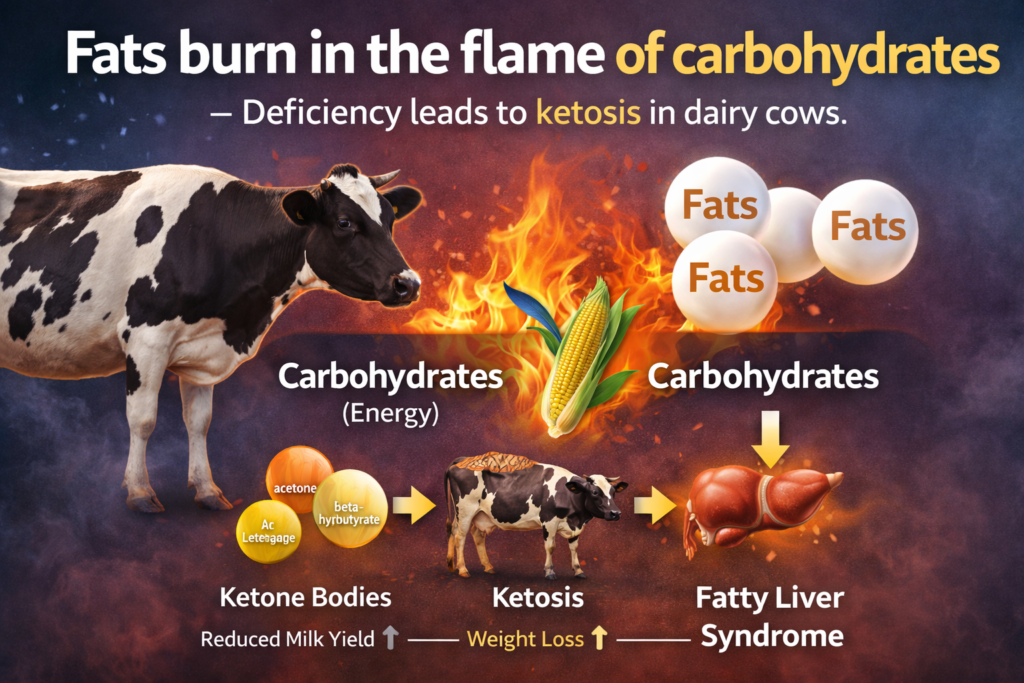
Fats burn in a carbohydrate flame.
Without sufficient carbohydrates, fat combustion remains incomplete.
🐄 Relevance to Ketosis and Negative Energy Balance in Dairy Cows
In early lactation, high-yielding dairy cows enter a state of negative energy balance (NEB) because:
- Milk energy output increases rapidly
- Feed intake lags behind energy demand
To compensate, cows mobilize large amounts of body fat. However, if carbohydrate supply is insufficient:
- Oxaloacetate becomes limiting
- Fat oxidation becomes incomplete
- Ketone bodies (BHB, acetoacetate) accumulate
This leads to:
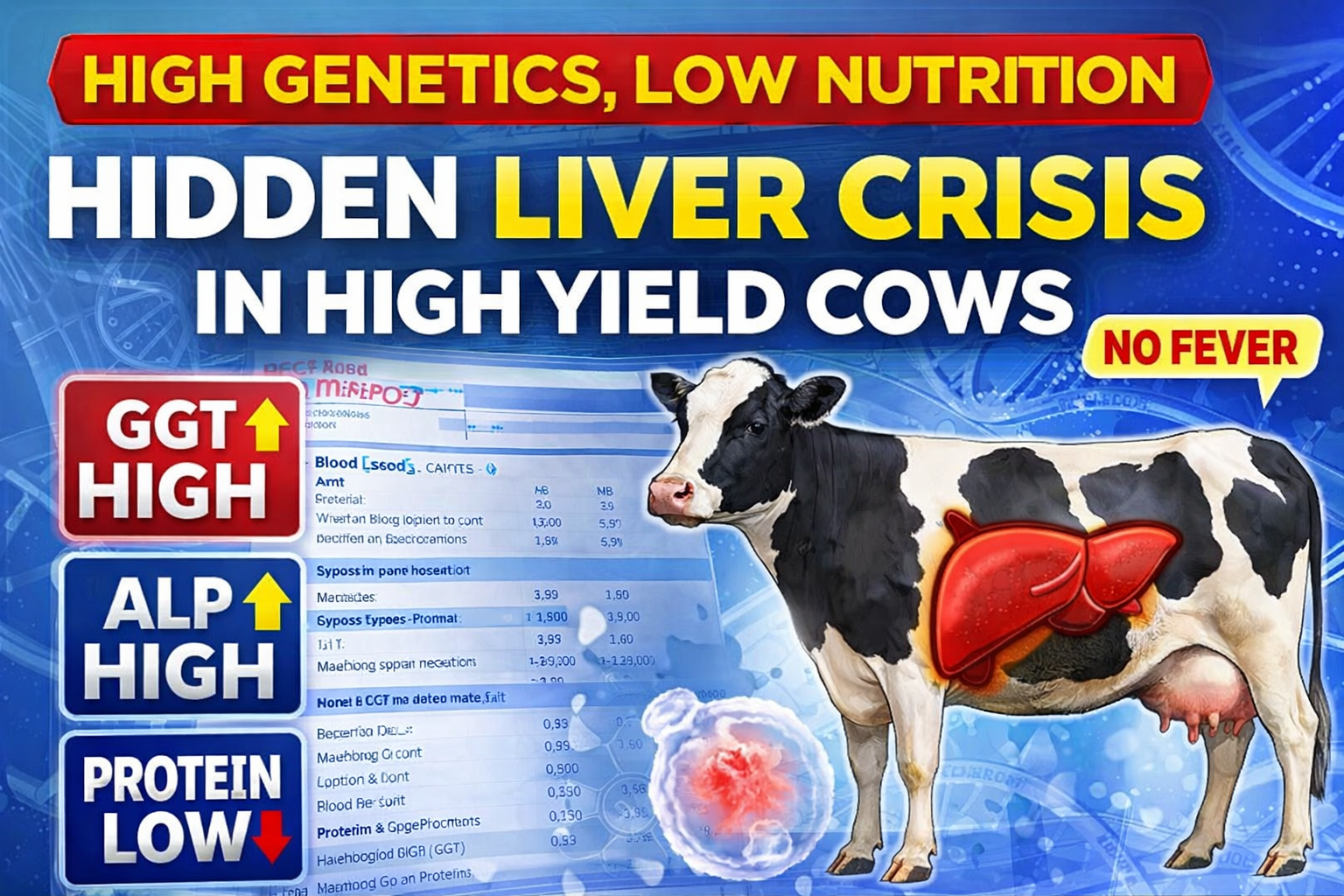
- Clinical and subclinical ketosis
- Fatty liver syndrome
- Reduced milk yield
- Poor fertility
- Increased risk of displaced abomasum and infections
🥚 Fatty Liver in Egg-Laying Hens
A similar metabolic phenomenon occurs in high-producing laying hens, where:
- High-energy diets
- Imbalanced amino acids
- Deficiency of key vitamins
lead to excessive fat deposition in the liver. Fatty liver hemorrhagic syndrome is a major cause of sudden mortality and drop in egg production.
🚩 Why Fat Accumulation Is Difficult to Reverse
Once fat accumulates in liver cells, it becomes functionally irreversible in many cases. Fat infiltration:
- Disrupts liver metabolism
- Reduces glucose production
- Impairs detoxification
However, high genetic merit dairy cows have a better ability to mobilize fat if metabolic pathways are supported through nutrition.
🧬 Role of Vitamins and Nutrients in Fat Mobilization
Certain vitamins and feed additives play a critical role in supporting carbohydrate metabolism, liver function and fat export from the liver.
Key Nutritional Interventions
Niacin (Vitamin B3)
- 892 – 2213 mg/day
- Ruminal escape: 1.5 – 6.2%
- Reduces excessive fat mobilization and ketone formation
Vitamin B12 (Cobalamin)
- 73 – 102 mg/day
- Ruminal escape: 10 – 37%
- Essential for propionate metabolism and glucose synthesis
Rumen-Protected Choline
- 10 – 20 g/day
- Required for phospholipid synthesis
- Helps export fat from liver as VLDL
- Supports acetylcholine synthesis and methylation reactions
Biotin
- 10 – 20 mg/day
- Supports gluconeogenesis and hoof health
🔥 Glucogenic Compounds: Fuel for the Carbohydrate Flame
Certain compounds provide glucose precursors that increase oxaloacetate availability, enabling complete fat oxidation.
- Metacure: 150 g/day
- Ketofend 1,2-propanediol: 200 g/day
These compounds are converted to glucose in the liver, restoring the citric acid cycle and preventing ketosis.
🎯 Practical Feeding Strategy for Ketosis Prevention
- Ensure adequate fermentable carbohydrates in early lactation diets
- Avoid excessive fat mobilization
- Use glucogenic supplements strategically
- Support liver function with choline, B12 and niacin
- Maintain balanced amino acid supply
Ketosis is not merely a disease — it is a failure of metabolic coordination between fat and carbohydrate metabolism.
🔑 Key Takeaway
Fat mobilization alone does not solve energy deficiency.
Only when sufficient carbohydrates are available can fat be fully utilized.
That is why:
Fats burn in the flame of carbohydrates.
दूध देने वाली गायों में अक्सर यह समस्या देखी जाती है कि दूध उत्पादन बढ़ने के बाद शरीर में ऊर्जा की कमी हो जाती है, जिसे Negative Energy Balance कहते हैं। इस स्थिति में गाय अपने शरीर की चर्बी (fat) को तोड़कर ऊर्जा बनाती है। लेकिन चर्बी से पूरी ऊर्जा तभी बनती है जब शरीर में पर्याप्त मात्रा में कार्बोहाइड्रेट मौजूद हो।
कार्बोहाइड्रेट से बनने वाला Oxaloacetate फैट के टूटने से बने Acetyl-CoA को सही तरीके से इस्तेमाल करने में मदद करता है। अगर आहार में कार्बोहाइड्रेट कम है, तो फैट पूरी तरह नहीं जल पाता और ketone bodies बनती हैं, जिससे ketosis और fatty liver जैसी बीमारियाँ होती हैं।
इसीलिए कहा जाता है कि
👉 फैट, कार्बोहाइड्रेट की आग में जलता है।इस समस्या को रोकने के लिए:
- किटोफेंड, मेटाक्योर जैसे ग्लूकोज बनाने वाले तत्व
- कोलीन, विटामिन B12, नायसिन (बायोनाईस)
को सही मात्रा में देना बहुत जरूरी है।सही फीडिंग स्ट्रेटेजी अपनाकर ketosis से बचा जा सकता है और दूध उत्पादन सुरक्षित रखा जा सकता है।