
Expert Insight: Why Eggs Have White Membrane — Poultry Veterinary Explanation
Egg Yolk’s Unexpected Membranous Structure in Layer Hens
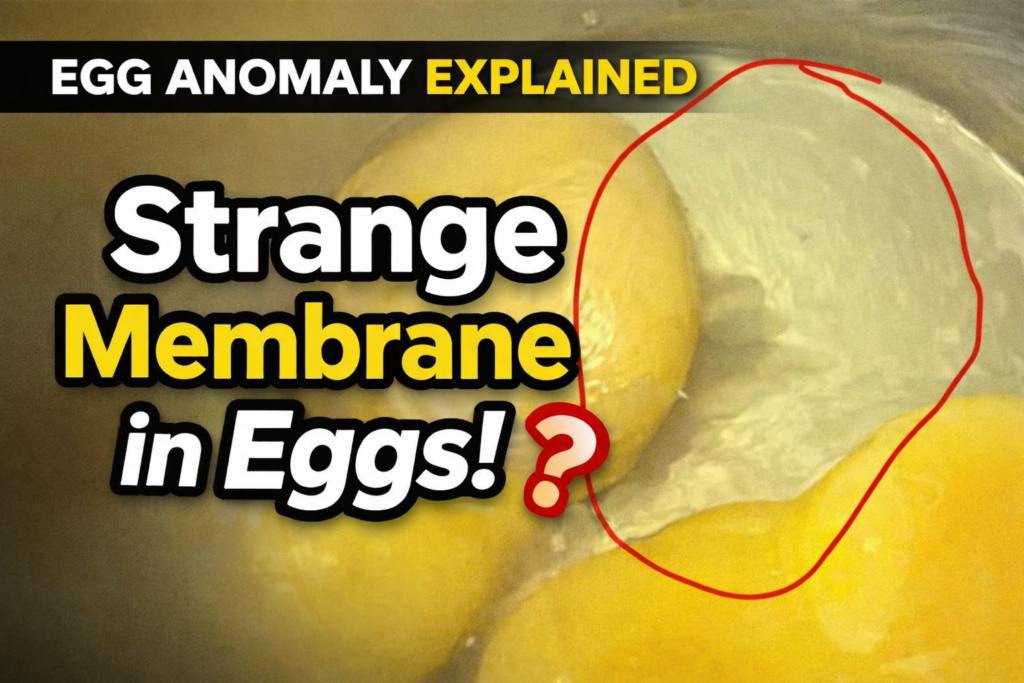
Egg yolk quality is vital in the table eggs market. Abnormal egg yolk contents are frequently reported by layer farmers, especially in flocks that otherwise appear clinically normal. One such finding is a membranous or whitish sheet-like structure attached to the yolk or albumen.
“Bahut baar problem egg ke bahar nahi, andar signal ke form me hoti hai.”
This observation often creates anxiety because farmers immediately associate it with disease or fertility problems. However, field experience suggests that not all abnormal egg structures are pathological.
Understanding the characteristics of the egg yolk can help farmers address potential issues early. Egg yolk analysis is a vital practice to ensure that egg quality meets market standards. However, this problem does not have any link with its eating value, egg remain absolutely fine for eating purpose.
The egg yolk is a crucial part of the egg’s structure, providing essential nutrients.
Egg formation is a complex physiological process involving precise coordination between hormonal signals, metabolic energy, and oviduct tissue health. The yolk is released from the ovary and then passes through different segments of the oviduct, where albumen, membranes, and shell are sequentially added.
“Egg formation ek chain reaction hai, jisme ek link bhi disturb ho jaaye to output change ho jata hai.”
Any abnormalities observed in the egg yolk should be closely monitored for quality assurance.
When there is even a mild disturbance in albumen secretion or epithelial integrity of the oviduct, excess protein material or membranous extensions can appear inside the egg. Importantly, this can occur without any visible clinical signs in the bird.
Such structures are often mistaken for embryonic development. In reality, the absence of vascularization and organized growth clearly differentiates these formations from embryos.
“Ye fertility ka proof nahi hota, ye physiology ka signal hota hai.”
Maintaining the health of the egg yolk is essential for overall egg production quality.
In mid-to-late lay, hens experience increased metabolic load due to sustained egg production. Calcium metabolism, phosphorus utilization, and vitamin availability become critical factors influencing egg quality. Subtle deficiencies or imbalances may not immediately affect shell thickness or production numbers but can alter internal egg composition.
A healthy egg yolk can indicate the overall well-being of the hen.
Proactive measures can ensure that the egg yolk remains healthy and nutrient-rich.
“Production normal rehna matlab system perfect hai — ye zaruri nahi.”
Field observations indicate that these abnormalities often reflect early stress on the reproductive system rather than overt disease. Ignoring such signs may lead to future issues like inconsistent egg quality, albumen thinning, or production instability.
Supportive nutritional strategies are therefore commonly considered in such situations. Multivitamin formulations like Vitaden, which provide vitamins A, D3, E, C, and Niacin, are used to support tissue health, stress management, and overall metabolic efficiency in layers, as highlighted in Poultry literature.
“Vitamin support ka matlab medicine nahi, system ko strength dena hota hai.”
Monitoring variations in egg yolk quality is essential in poultry management.
Similarly, maintaining calcium and phosphorus balance is essential not only for shell formation but also for muscle function and internal egg quality. Pyrocal-B, a liquid calcium-phosphorus supplement enriched with trace minerals and B-complex vitamins, is often utilized in field practice to improve mineral utilization and flock uniformity Poultry Product Range.
“Calcium sirf shell ke liye nahi, pura reproductive rhythm usse linked hota hai.”
Another important aspect often overlooked in such cases is the role of subtle stressors that do not immediately reflect in production data. Layers may continue laying normal-shelled eggs while internal physiological adjustments are taking place.
“Hen ka body bahar se normal dikhta hai, par andar adjustment chal rahi hoti hai.”
Analyzing egg yolk quality can provide insights into the flock’s dietary needs.
These stressors may include environmental fluctuations, minor feed formulation changes, water quality variations, or even routine management practices. Individually, these factors may seem insignificant, but collectively they can influence oviduct function and protein deposition during egg formation.
Farmers can benefit significantly from understanding the role of the egg yolk in egg production.
It is important to understand that such products are supportive tools, not universal solutions. Each flock has unique nutritional, environmental, and physiological variables that must be evaluated before any intervention.
The key takeaway from such cases is not to panic but to interpret egg abnormalities as biological signals. When understood correctly, these signals provide an opportunity for early correction and better long-term flock performance.
“Jo farmer signal padh leta hai, wahi future loss se bach jata hai.”
Ali Veterinary Wisdom continues to document and discuss real poultry field cases to build a practical knowledge base that helps farmers and veterinarians move beyond guess-based treatments toward informed decision-making.