
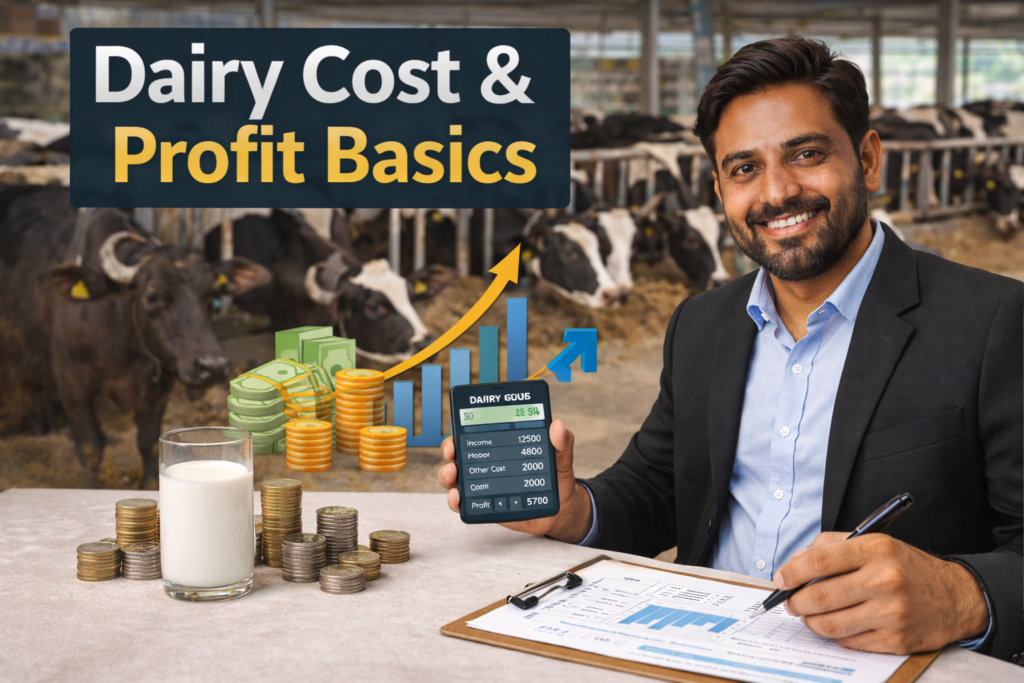
Dairy Cost & Profit Basics in India
Understanding Investment, Expenses, Milk Yield and Real Profit in Dairy Farming
Dairy farming is not just about keeping cows or buffaloes; it is a daily operating business where money is spent and earned every single day. Many dairy farms fail not because animals are weak or milk price is low, but because costs are not understood and profits are not calculated correctly.
If you are asking questions like:
- Is dairy farming profitable in India?
- How much investment is required to start a dairy farm?
- What are the monthly expenses in dairy farming?
- How much milk is needed to break even?
then this guide will help you understand dairy cost and profit in a practical, business-oriented way, without complicated calculations but with clear financial logic.
Why Understanding Cost and Profit Is Critical in Dairy Farming
In dairy farming, income comes in small daily amounts, while expenses quietly accumulate. Farmers who do not track costs often feel that “money is coming but savings are not growing.” This usually happens because feed cost, labour cost and hidden expenses are not evaluated against milk income.
A profitable dairy farm is not one that produces the most milk, but one that produces milk at the lowest cost per litre while maintaining animal health and long-term productivity.
Initial Investment in Dairy Farming (Startup Cost)
Initial investment is the money required before milk income starts. This cost depends on farm size, location, and management level.
Major components of initial investment include:
- Purchase of dairy animals (cows or buffaloes)
- Construction of animal shed and flooring
- Water supply system and storage tanks
- Basic equipment such as mangers, buckets and tools
- Initial feed stock and working capital
Small dairy farms require lower initial investment, while medium and commercial dairy farms need higher capital. However, higher investment does not automatically mean higher profit unless daily management is efficient.
Monthly Operating Cost: The Real Profit Decider
Monthly expenses determine whether a dairy farm makes profit or loss. Even a high-yielding animal can become unprofitable if monthly costs are uncontrolled.
Key monthly expenses in dairy farming:
- Feed cost (dry fodder, green fodder, concentrate and mineral mixture)
- Labour cost (family or hired labour)
- Electricity and water expenses
- Veterinary care, vaccination and basic medicines
- Maintenance and repair of shed and equipment
Among all expenses, feed cost alone usually accounts for the largest share, which is why feeding efficiency directly affects profit margins.
Feed Cost and Its Impact on Milk Profitability
Feed cost is the backbone of dairy economics. Poor feeding increases cost per litre of milk, while balanced feeding reduces expenses even if concentrate quality improves.
Important points to understand:
- Overfeeding concentrate increases cost without proportional milk gain
- Poor quality straw reduces feed intake and milk yield
- Skipping mineral mixture affects fertility and long-term production
A well-balanced ration improves feed efficiency, meaning more milk from the same or lower feed cost, which is essential for sustainable dairy profit.
Milk Yield, Milk Price and Daily Income Logic
Daily milk income depends on:
- Average milk yield per animal
- Number of lactating animals
- Milk price (fat-based or volume-based)
Higher milk yield alone does not guarantee higher profit. If milk yield increases but feed and labour costs rise faster, net income may still remain low. Therefore, profit should always be evaluated per litre of milk, not just per animal.
Understanding Break-Even in Dairy Farming
Break-even means the point where total milk income equals total expenses. Before reaching break-even, the farm is only covering costs.
Key factors affecting break-even:
- Initial investment size
- Monthly operating expenses
- Average milk yield and price
- Animal health and fertility
Farms that manage feeding, disease prevention and labour efficiently reach break-even earlier than those focusing only on animal numbers.
Small vs Medium vs Commercial Dairy Farm Profitability
Small dairy farms benefit from:
- Lower labour cost
- Better individual animal care
- Lower financial risk
Medium and commercial farms benefit from:
- Better scalability
- Organized workflow
- Potential for long-term expansion
However, large farms also carry higher risks if management discipline is weak. Scale increases profit only when systems are strong.
Hidden Costs That Reduce Dairy Profit
Many farmers ignore hidden costs that slowly eat into profits:
- Milk loss due to mastitis or disease
- Reduced fertility and repeat breeding
- Feed wastage at the manger
- Animal replacement cost due to poor health
Controlling these hidden costs often improves profitability more than increasing herd size.
Why Dairy Profit Should Be Calculated Per Litre of Milk
Smart dairy farmers always think in terms of:
Cost per litre vs selling price per litre
When cost per litre goes down and milk price remains stable, profit automatically improves. This logic makes it easier to evaluate feeding changes, management decisions and future investments.
Cost of Milk Production: 30 Litre vs 40 Litre Animal (Practical Comparison)
One of the biggest myths in dairy farming is that higher milk yield always means higher cost. In reality, cost per litre of milk usually comes down as production increases, provided feeding is balanced and efficient.
Let us understand this with a simple, realistic Indian feeding example, using current average feed prices.
Assumed Feed Costs
- Silage: ₹6 per kg
- Concentrate: ₹40 per kg
- Straw (bhusa): ₹6 per kg
(Prices are indicative and used only for comparison logic.)
Example 1: Animal Producing 30 Litres Milk per Day
Daily feeding pattern (approximate):
- Silage: 20 kg → ₹120
- Straw: 6 kg → ₹36
- Concentrate: 8 kg → ₹320
Total daily feed cost:
👉 ₹476 per day
Milk production: 30 litres
Feed cost per litre of milk:
👉 ₹15.9 per litre
Example 2: Animal Producing 40 Litres Milk per Day
Daily feeding pattern (approximate):
- Silage: 22 kg → ₹132
- Straw: 6 kg → ₹36
- Concentrate: 10 kg → ₹400
Total daily feed cost:
👉 ₹568 per day
Milk production: 40 litres
Feed cost per litre of milk:
👉 ₹14.2 per litre
What This Comparison Clearly Shows
- Feed cost increases, but not in the same proportion as milk yield
- The 40-litre animal produces 33% more milk, but feed cost increases by only about 19%
- Cost per litre of milk is lower in the higher-producing animal
- Maintenance cost of the animal (housing, labour, basic care) remains almost the same in both cases
👉 This is why efficient high-yielding animals are more profitable, not because they eat less, but because they convert feed into milk more efficiently.
Key Business Insight for Dairy Farmers
In dairy economics:
Profit is decided by cost per litre, not total feed cost.
An animal giving 40 litres with proper nutrition, health care and comfort usually:
- Has better feed efficiency
- Produces cheaper milk per litre
- Covers fixed costs faster
This logic is the foundation for:
- Milk production cost calculators
- Feed efficiency analysis
- Cow vs buffalo profit comparison
- Expansion and investment planning
👉 In the next detailed article, we will break this down further using:
- Fixed cost vs variable cost
- Lactation stage differences
- Cow vs buffalo comparison
- Real farm-level calculator logic
For now, this simple comparison clearly explains why productivity matters more than just feed price.
Preparing Your Farm for Profit Calculation Tools
Understanding cost and profit basics prepares farmers for:
- Milk cost calculators
- Feed cost analysis tools
- Profit comparison between cows and buffaloes
- Expansion planning
When farm data is already structured (milk yield, feed cost, expenses), calculators become useful decision-making tools rather than confusing numbers.
Learn Modern Dairy Business Management (Optional)
Many dairy farmers produce milk successfully but struggle with financial planning due to lack of structured business training.
For farmers interested in modern dairy business management, cost control and profit planning, structured learning is available.
📞 Call / WhatsApp: +91-9871584101
📧 Email: ibnester@gmail.com
The Ali Veterinary Wisdom App offers a complete Modern Dairy Practices course, designed to help farmers understand both production and profitability (optional learning resource).
Final Business Takeaway
Dairy farming becomes profitable when:
- Costs are understood and controlled
- Feeding is balanced and efficient
- Milk yield is evaluated against expenses
- Decisions are taken based on data, not assumptions
A successful dairy farm is not built by chance, but by consistent financial awareness and smart daily management.
You can connect with our veterinary team directly.
WhatsApp / Call: +91-9871584101
Email: ibnester@gmail.com
🐄 दूध उत्पादन की लागत को समझना – डेयरी बिज़नेस का असली आधार
डेयरी फार्मिंग में मुनाफा इस बात से तय नहीं होता कि पशु कितना दूध दे रहा है, बल्कि इस बात से तय होता है कि एक लीटर दूध बनाने में कितना खर्च आ रहा है। बहुत से किसान केवल रोज़ का दूध देखकर खुश हो जाते हैं, लेकिन जब महीने के अंत में पैसे हाथ में नहीं आते, तब समझ में आता है कि कहीं न कहीं दूध की लागत ज्यादा है।
डेयरी बिज़नेस में दो तरह के खर्च होते हैं — कुछ खर्च रोज़ होते हैं जैसे फीड, और कुछ खर्च लगभग स्थायी होते हैं जैसे शेड, मज़दूरी और देखभाल। इन स्थायी खर्चों का सबसे बड़ा फायदा तभी मिलता है जब पशु ज़्यादा दूध देकर इन्हें जल्दी कवर कर दे। इसी वजह से सिर्फ कम खर्च पर फीड देना हमेशा फायदेमंद नहीं होता, बल्कि फीड की दक्षता (feed efficiency) सबसे ज़्यादा मायने रखती है।
सरल शब्दों में कहें तो:
डेयरी में असली सवाल यह नहीं है कि “पशु कितना खा रहा है”,
बल्कि यह है कि “वह खाकर कितना दूध बना रहा है।”
जब यही सोच डेयरी फार्म में आ जाती है, तभी किसान दूध उत्पादन की लागत को सही तरीके से समझ पाता है।
🧠 दूध की लागत कैसे बनती है (Cost of Milk Production Logic)
दूध उत्पादन की लागत मुख्य रूप से प्रति लीटर दूध के हिसाब से देखी जानी चाहिए। इसमें सबसे बड़ा हिस्सा फीड का होता है, जबकि मज़दूरी, बिजली, पानी और शेड का खर्च ज़्यादातर मामलों में दूध बढ़ने पर उसी अनुपात में नहीं बढ़ता।
इसका मतलब यह है कि:
- अगर दूध थोड़ा बढ़े, तो कुल खर्च थोड़ा बढ़ता है
- लेकिन अगर दूध अच्छा बढ़े, तो प्रति लीटर खर्च कम हो जाता है
यही लॉजिक आगे चलकर:
- दूध की लागत कैलकुलेटर
- फीड प्लानिंग
- नस्ल चयन
- डेयरी विस्तार (expansion)
सब में काम आता है।
📊 अब समझते हैं एक व्यावहारिक उदाहरण से
30 लीटर बनाम 40 लीटर दूध देने वाले पशु की तुलना
अब इस लॉजिक को हम भारतीय परिस्थितियों के एक सरल उदाहरण से समझते हैं, जिसमें आमतौर पर इस्तेमाल होने वाले फीड और उनकी औसत कीमतें ली गई हैं।
मान ली गई फीड कीमतें (उदाहरण)
- साइलेज: ₹6 प्रति किलो
- कंसन्ट्रेट फीड: ₹40 प्रति किलो
- भूसा (Straw): ₹6 प्रति किलो
(यह दरें केवल समझाने के लिए ली गई हैं।)
🟢 30 लीटर दूध देने वाला पशु
ऐसे पशु को सामान्यतः इस प्रकार का आहार दिया जाता है:
- साइलेज: 20 किलो → ₹120
- भूसा: 6 किलो → ₹36
- कंसन्ट्रेट: 8 किलो → ₹320
कुल दैनिक फीड खर्च:
👉 ₹476 प्रति दिन
दूध उत्पादन:
👉 30 लीटर प्रतिदिन
प्रति लीटर दूध की लागत (सिर्फ फीड):
👉 लगभग ₹15.9 प्रति लीटर
🟢 40 लीटर दूध देने वाला पशु
अब एक उच्च क्षमता वाले पशु को देखें:
- साइलेज: 22 किलो → ₹132
- भूसा: 6 किलो → ₹36
- कंसन्ट्रेट: 10 किलो → ₹400
कुल दैनिक फीड खर्च:
👉 ₹568 प्रति दिन
दूध उत्पादन:
👉 40 लीटर प्रतिदिन
प्रति लीटर दूध की लागत (सिर्फ फीड):
👉 लगभग ₹14.2 प्रति लीटर
🔍 इस तुलना से क्या निष्कर्ष निकलता है?
इस उदाहरण से यह साफ़ समझ में आता है कि:
- 40 लीटर देने वाले पशु का कुल फीड खर्च ज़्यादा है
- लेकिन दूध उत्पादन उससे कहीं ज़्यादा बढ़ा है
- इसलिए प्रति लीटर दूध सस्ता पड़ रहा है
30 लीटर से 40 लीटर जाने पर दूध उत्पादन लगभग 33% बढ़ा, जबकि फीड खर्च केवल 18–20% के आसपास बढ़ा। यही कारण है कि ज़्यादा क्षमता वाला और सही पोषण पाने वाला पशु डेयरी बिज़नेस के लिए ज़्यादा फायदेमंद होता है।
💡 डेयरी फार्मर के लिए सबसे ज़रूरी सीख
डेयरी फार्मिंग में मुनाफा बढ़ाने के लिए:
- सिर्फ फीड सस्ता करने पर ध्यान न दें
- पशु की उत्पादन क्षमता और फीड दक्षता बढ़ाने पर ध्यान दें
जब किसान प्रति लीटर दूध की लागत समझ लेता है, तब वह:
- फीड बदलने का सही फैसला ले सकता है
- सही नस्ल और सही पोषण चुन सकता है
- भविष्य में कैलकुलेटर और डेटा का सही उपयोग कर सकता है
✅ अंतिम बात
डेयरी फार्मिंग में:
ज़्यादा दूध = ज़्यादा खर्च नहीं,
अगर फीडिंग और मैनेजमेंट सही हो।
सही पोषण और सही सोच से ज़्यादा दूध देने वाला पशु ही सस्ता दूध बनाता है — और यही डेयरी बिज़नेस की असली सफलता है।