
Cow Heat Medicine: Hormones, Brands, and the Scientific Truth Behind Their Use

Cow heat medicine is one of the most searched topics in dairy farming today. Every farmer wants a simple answer to one question: Which injection will bring my cow into heat? Unfortunately, reproductive physiology does not work on shortcuts. Heat is not a drug-dependent event; it is a biologically regulated hormonal process. When hormones are used without understanding this process, the result is often temporary heat, poor conception, repeat breeding, or long-term fertility damage.
This article explains the science behind cow heat, the major hormone categories used in heat induction, commonly available brands, and most importantly, why indiscriminate hormone use can disrupt the ovarian cycle instead of correcting it.
Understanding Cow Heat as a Biological Process
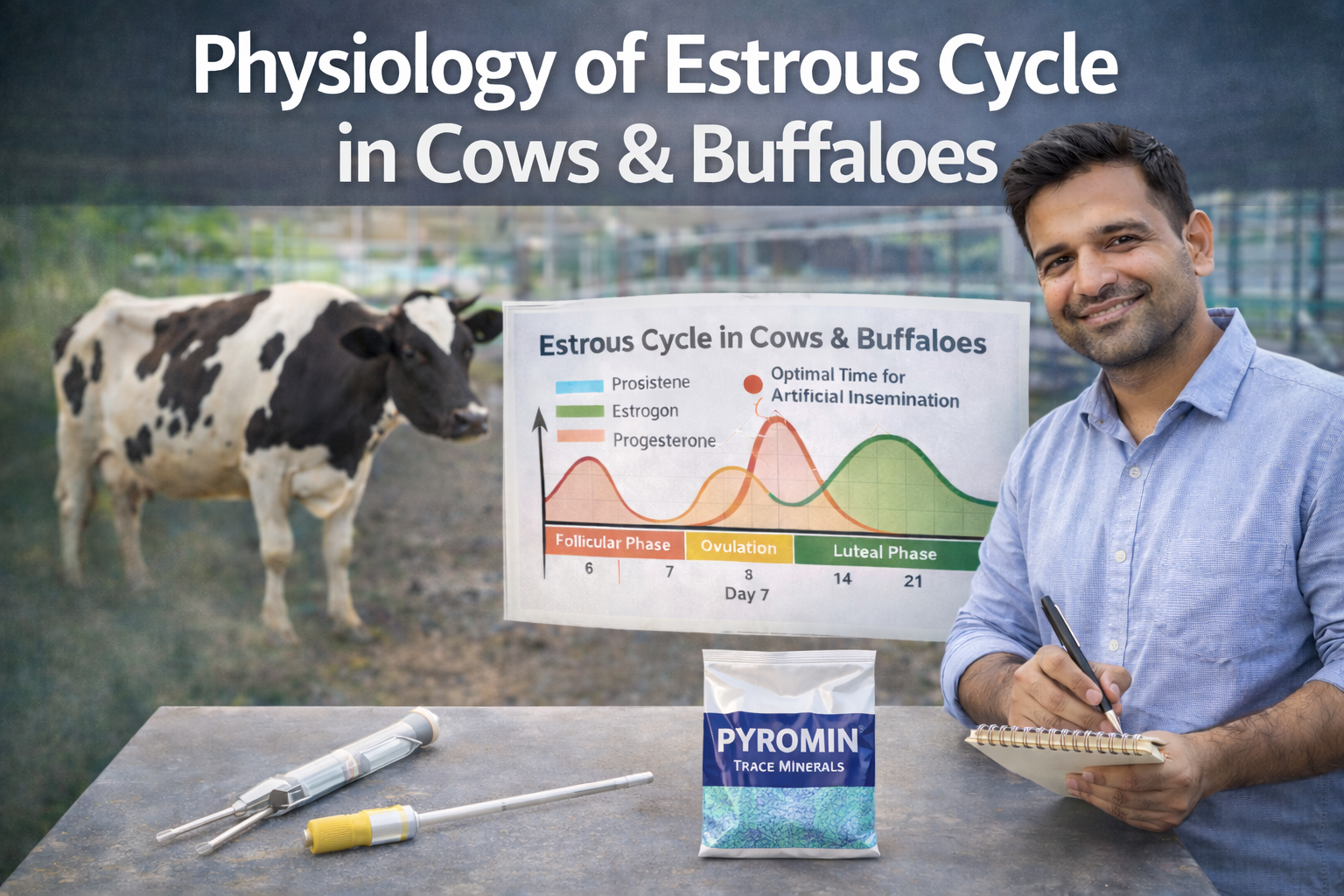
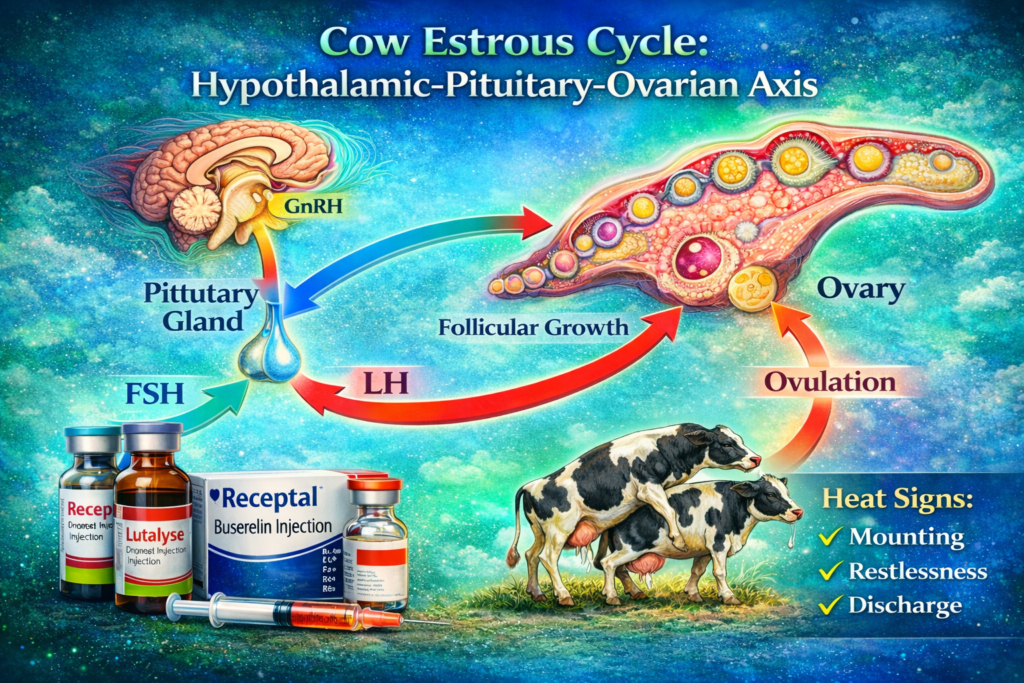
Estrus, commonly called heat, is the outward expression of a normal ovarian cycle. This cycle is controlled by a tightly regulated system known as the hypothalamic–pituitary–ovarian (HPO) axis.
The hypothalamus releases Gonadotropin Releasing Hormone (GnRH), which stimulates the pituitary gland to release Follicle Stimulating Hormone (FSH) and Luteinizing Hormone (LH). These hormones act on the ovary, leading to follicular growth. As the follicle matures, it produces estrogen, which is responsible for visible heat signs. Ovulation occurs only after a precisely timed LH surge.
If any part of this axis is disturbed—nutrition, uterine health, metabolic stress, or incorrect hormone use—heat expression becomes weak, irregular, or completely absent.
“Heat injection tab kaam karta hai jab body pehle se ready ho — injection heat nahi banata, sirf process ko support karta hai.”
Why Cows Fail to Show Heat
Failure of heat is rarely due to a single cause. In field conditions, it is usually a multifactorial problem.
Post-partum negative energy balance is one of the most common reasons. After calving, a cow prioritizes milk production over reproduction. If energy intake does not meet output, the brain suppresses reproductive hormones. In such cases, no hormone injection can override basic physiology.
Mineral imbalance—especially phosphorus, copper, selenium, and zinc—directly affects ovarian activity. Many cows labeled as “anoestrus” are actually suffering from subclinical mineral deficiencies.
Another major but often ignored factor is subclinical uterine infection. Even when there is no foul-smelling discharge, low-grade inflammation inside the uterus releases inflammatory mediators that suppress ovarian function. Treating heat without addressing uterine health is one of the biggest mistakes in dairy reproduction.
Silent heat is another challenge. In these cows, ovulation occurs but estrogen levels are insufficient to produce strong external signs. These cases are often misdiagnosed as true anoestrus and unnecessarily treated with hormones.
Categories of Cow Heat Medicines (Hormonal Perspective)
Most cow heat medicines fall into a few major hormone categories. Brand names may differ, but the physiological action remains the same.
GnRH-Based Hormones
GnRH-based hormones stimulate the pituitary gland to release LH, which can induce ovulation in responsive ovaries. These hormones work only when a functional follicle is already present.
Common brands include Receptal, Fertagyl, Cystorelin, and Gynarich. Despite different brand names, the active hormone is essentially the same.
GnRH is often misunderstood as a universal heat inducer. In reality, it cannot create a follicle; it can only act on an existing one. Using GnRH without confirming ovarian status often results in treatment failure.
Prostaglandin (PGF2α) Hormones
Prostaglandins cause regression of the corpus luteum (CL), leading to a drop in progesterone and allowing the cow to return to heat.
Popular brands include Lutalyse, Vetmate, Dinoprost, Clostenol, Prosolvin, Pragma, and Iliren.
The most critical limitation of prostaglandins is that they work only if a functional CL is present. Administering prostaglandins blindly, without confirming CL presence, is one of the most common examples of hormone misuse in dairy practice.
“Galat stage par diya gaya prostaglandin treatment nahi, sirf time waste hota hai.”
Progesterone-Based Hormones
Progesterone-based treatments are used to manipulate or synchronize the estrous cycle. These hormones temporarily simulate a pregnancy-like hormonal environment. When withdrawn, the body responds with a rebound heat.
Common injectable brands include Hydroxy Progesterone Caproate, Proluton Depot, Duraprogen, P-Depot, Triprogen, and Megadepot.
While progesterone can help regulate cycles, its repeated or inappropriate use can suppress natural ovarian activity. Over time, the ovary becomes less responsive, increasing the risk of delayed ovulation and repeat breeding.
Estrogen-Based Hormones
Estrogen enhances heat signs by increasing uterine tone, cervical relaxation, and visible estrus behavior. Brands such as Progynon Depot, Oestradiol Benzoate, Premarin, and Stilboestrol are available in some markets.
However, estrogen misuse carries significant risks. Excessive estrogen can suppress pituitary function, leading to cystic ovaries and long-term fertility problems. This is why estrogen use is now highly restricted and discouraged in many reproductive protocols.
Herbal and Non-Hormonal Heat Medicines
Herbal heat medicines are widely marketed as “safe alternatives.” These products may support metabolism, liver function, or general reproductive tone, but they cannot replace hormonal regulation.
They may be helpful in mild cases or as supportive therapy, but expecting herbal products to correct deep hormonal or uterine pathology is unrealistic.
Brand Confusion: Same Hormone, Different Names
One of the biggest misconceptions among farmers is that changing brands will change results. In reality, most brands differ only in manufacturer, not in hormonal action.
A cow that does not respond to one GnRH brand is unlikely to respond to another unless the underlying physiological condition has changed. Brand hopping without diagnosis only increases cost and delays proper treatment.
“Brand nahi, biology decide karti hai ki response aayega ya nahi.”
Ovarian Cycle Disruption Due to Hormone Misuse
Repeated use of hormones without understanding ovarian dynamics can severely disrupt the natural cycle. Incorrect timing of GnRH can lead to incomplete ovulation. Misuse of prostaglandins can create irregular luteal phases. Excess progesterone can suppress follicular waves.
Over time, these disruptions reduce pituitary sensitivity, alter follicular development, and increase the incidence of ovarian cysts. What starts as a simple heat problem often ends as repeat breeding or permanent subfertility.
Hormones are powerful tools, but they interfere directly with endocrine feedback loops. Any interference without knowledge carries consequences.
When Simple Heat Problems Become Complex Reproductive Failures
Many cases labeled as “hormone failure” are actually failures of diagnosis. Ignoring uterine health, nutrition, body condition, and calving history leads to repeated hormonal interventions with diminishing returns.
A cow that fails to conceive after multiple hormone treatments is not hormone-deficient—it is systemically compromised.
“Hormone tab fail hota hai jab hum cause nahi samajhte.”
Key Takeaway for Farmers and Practitioners
Cow heat medicine should never be chosen based on brand popularity or anecdotal success. Every cow has a unique reproductive status influenced by nutrition, uterine health, metabolic balance, and hormonal readiness.
Hormones should support physiology, not override it.
Blind hormone use may produce temporary heat, but sustainable fertility comes only from scientific understanding and case-specific decision-making.
Final Thoughts
The purpose of this article is not to promote or discourage any specific hormone brand. Its purpose is to promote thinking before injecting. When used correctly, hormones are invaluable tools. When misused, they quietly damage reproductive potential.
Every injection should be guided by physiology, not pressure.
“Samajh ke diya gaya hormone ilaaj hota hai, bina samajh diya gaya hormone nuksaan.”