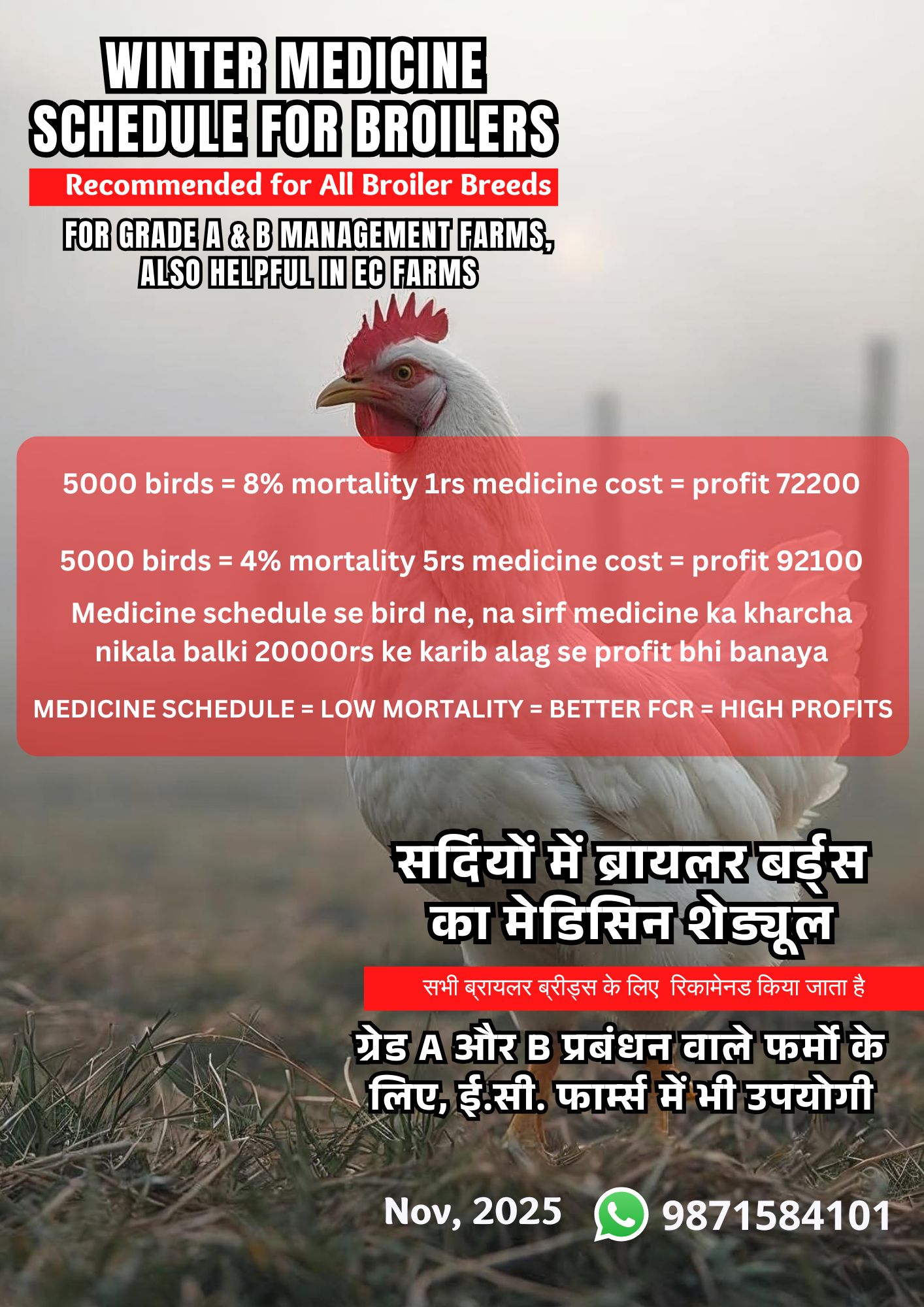

Broiler Integration Farming Earnings Calculator
Complete Guide to GC, CBW, cFCR, Incentives & Profit Planning
Broiler integration farming has transformed poultry production across India. Under this system, farmers are protected from market volatility, but at the same time, their income becomes entirely dependent on performance-based parameters decided by integration companies.
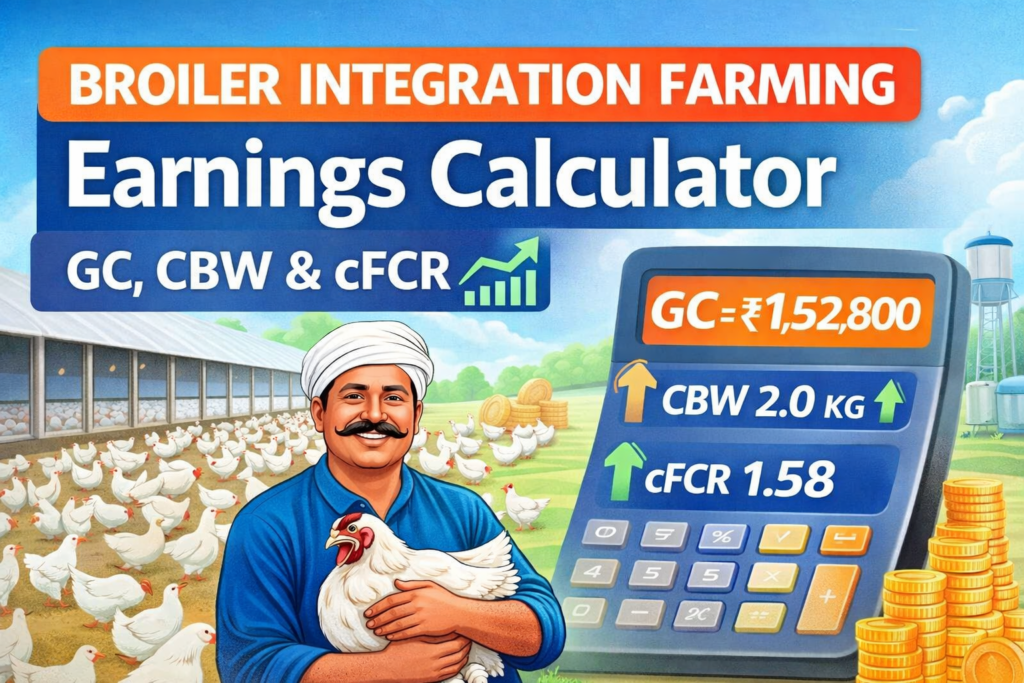
Despite working hard throughout the batch, many farmers are left confused at the time of payment:
- “GC kam kyun mila?”
- “Mera FCR theek tha, phir bhi slab neeche kyun chala gaya?”
- “Mortality thodi zyada thi, par itna nuksaan kaise?”
The core problem is not poor farming alone —
the real problem is lack of clarity in calculations.
This article explains, step by step, how integration earnings are actually calculated, how different parameters are connected, and how farmers can use calculators to plan, predict, and improve income, instead of being surprised after lifting.
Is system me sab kuch numbers se chalta hai, aur numbers ko samajhna hi sabse bada weapon hai farmer ke paas.
Integration farming me farmer ko lagta hai ki company hi sab decide karti hai, lekin asal me company ke rules numbers ke through kaam karte hain. Agar numbers samajh aa gaye, to planning possible ho jaati hai.
Understanding the Structure of Integration Farmer Income
In an integration model, farmers are not paid per bird or per kg market rate. Instead, earnings are calculated through a layered structure:
- Base Growing Charges (GC)
- Performance-linked slab system
- Corrected parameters (CBW & cFCR)
- Shed-type differentiation
- Additional incentives
Every layer depends on the previous one.
A mistake or weakness at any stage flows downstream and multiplies the loss.
This is why professional planning always starts from the root parameters, not from GC slabs directly.
Integration me income ek single factor se decide nahi hoti. Ek chain hoti hai, aur agar chain ke start me gadbad ho jaaye, to end me GC apne aap gir jaata hai.
Corrected Body Weight (CBW): The Foundation of Everything
Corrected Body Weight (CBW) is the most misunderstood yet most powerful parameter in integration farming.
Many farmers believe body weight is simply:
Total weight ÷ lifted birds
This is only partially true.
Integration companies apply a mortality correction to ensure farmers do not benefit from excessive mortality.
CBW Logic (Industry Standard)
- If mortality ≤ 5%
→ CBW = Total lifted weight ÷ lifted birds - If mortality > 5%
→ CBW = Total lifted weight ÷ (95% of chicks housed)
This single correction has massive consequences.
Example:
- Birds housed: 10,000
- Mortality: 8%
- Lifted birds: 9,200
- Company will still divide total weight by 9,500 birds, not 9,200
Result:
- CBW drops
- cFCR increases
- GC slab drops
Even if feed and management were otherwise good.
Mortality 5% cross karte hi company assume karti hai ki baaki birds ka weight artificially high dikh raha hai, isliye CBW ko forcefully kam kar diya jaata hai. Yahin se maximum loss shuru hota hai.
Why CBW Calculator Is the Entry Gate
Without CBW, no further calculation makes sense.
- cFCR cannot be trusted
- GC slab becomes inaccurate
- Incentives become meaningless
Once CBW is calculated, all downstream calculators work logically.
CBW is not just a number —
it is a reflection of mortality control, brooding quality, and uniform growth.
CBW gatekeeper hai poore earning system ka. Agar CBW weak hai, to aage koi calculator farmer ke favour me kaam nahi karega.
Corrected FCR (cFCR): Where Most Farmers Lose Slabs
Traditional farmers still think in terms of simple FCR.
But modern integration payouts are based on corrected FCR (cFCR), which adjusts FCR based on body weight deviation.
General Industry Formula
cFCR = FCR + (2.0 – CBW) × 0.25
Meaning:
- If CBW < 2.0 kg → penalty added
- Lower CBW = higher penalty
- Good feed alone cannot save cFCR
This ensures that:
- Farmers focus on both feed efficiency and body weight
- Mortality indirectly affects FCR via CBW

Bahut se farmers bolte hain “mera FCR theek tha”. Lekin company FCR nahi, cFCR dekhti hai — aur cFCR CBW se bigad jaata hai.
Shed Type: Same Performance, Different Money
One of the most important but ignored aspects is shed classification.
Most integration policies differentiate payouts based on:
- Open Shed
- Semi Environment Controlled (Semi-EC)
- Fully Environment Controlled (EC)
For the same cFCR, payouts vary significantly.
Example:
- cFCR = 1.40–1.45
- Open Shed → lower GC
- Semi-EC → moderate GC
- EC → highest GC
Why?
Because companies assume:
- EC sheds have higher capital cost
- Better control should give better results
This makes shed selection a strategic long-term decision, not just a construction choice.
Same performance par bhi agar shed type alag hai, to paisa alag milega. Isliye shed sirf structure nahi, earning tool hai.
GC Slab Calculator: The Heart of Earnings
The GC Slab Calculator combines:
- cFCR
- Shed type
- Eligibility conditions
It answers the farmer’s most important question:
“Is performance par mujhe per kg kitna milega?”
This calculator helps farmers:
- Simulate “what-if” scenarios
- Set performance targets for next batch
Even a 0.05 improvement in cFCR can move a farmer into a higher slab, increasing earnings by lakhs over a full batch.
GC slab calculator farmer ko control deta hai. Ab wo andhere me kaam nahi karta, balki target ke saath kaam karta hai.
Incentives: Hidden Profit Zone
Base GC is only one part of income.
Companies reward farmers who maintain:
- Low mortality
- Good brooding
- Stable body weight
- Market alignment
Common Incentives
- Brooding Incentive
- Body Weight Incentive
- Market Rate Incentive
These incentives can add ₹1–3 per kg extra, which often decides whether a batch is average or highly profitable.
Incentives wahi farmer le paata hai jo sirf birds nahi, system ko manage karta hai.
Mortality: The Silent Income Killer
Across all integration systems, one truth is universal:
Mortality destroys income faster than feed cost.
Each extra 1% mortality:
- Reduces CBW
- Increases cFCR
- Pushes GC slab downward
- Cancels incentives
Most mortality losses are preventable, not accidental.
Common causes:
- Poor brooding temperature
- Delayed feed intake
- Gut health imbalance
- Preventable diseases
Impact of Mortality on CBW, cFCR & GC – Data Illustration
Assumptions (Fixed for all cases)
- Chicks housed: 10,000
- Target body weight (ideal): 2.00 kg
- Feed consumed per bird: 3.20 kg
- Actual FCR (batch): 1.60
- Shed type: Open Shed
- GC slab reference: as per standard slabs
- CBW correction applies after 5% mortality
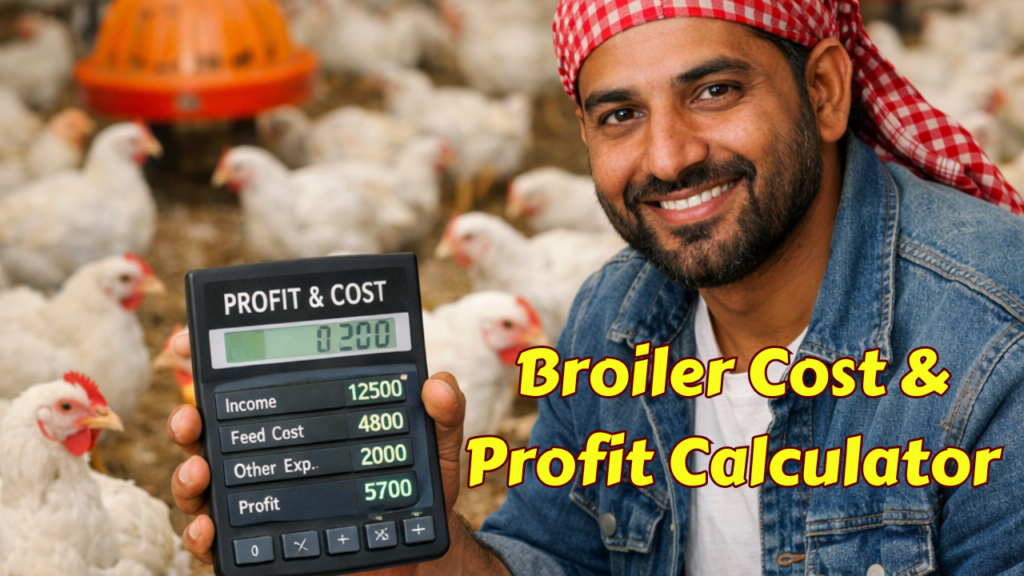
Case-wise Comparison
Case 1: Mortality = 4% (Below Threshold)
| Parameter | Value |
|---|---|
| Birds lifted | 9,600 |
| Total lifted weight | 19,200 kg |
| CBW calculation | 19,200 ÷ 9,600 |
| CBW | 2.00 kg |
| cFCR formula | 1.60 + (2.0 − 2.0) × 0.25 |
| cFCR | 1.60 |
| GC slab (Open) | ₹8.00 / kg |
| Incentives | Eligible |
Case 2: Mortality = 6% (Just crossed 5%)
| Parameter | Value |
|---|---|
| Birds lifted | 9,400 |
| Company divisor | 9,500 (95%) |
| Total lifted weight | 18,800 kg |
| CBW | 1.98 kg |
| cFCR | 1.60 + (2.0 − 1.98) × 0.25 |
| cFCR | 1.605 |
| GC slab | ₹7.00 / kg |
| Incentives | At risk |
Loss due to 1% extra mortality:
- GC drop: ₹1/kg
- On 18,800 kg = ₹18,800 loss
Case 3: Mortality = 7%
| Parameter | Value |
|---|---|
| Birds lifted | 9,300 |
| Company divisor | 9,500 |
| Total lifted weight | 18,600 kg |
| CBW | 1.96 kg |
| cFCR | 1.60 + (2.0 − 1.96) × 0.25 |
| cFCR | 1.61 |
| GC slab | ₹7.00 / kg |
| Incentives | Cancelled |
Case 4: Mortality = 9%
| Parameter | Value |
|---|---|
| Birds lifted | 9,100 |
| Company divisor | 9,500 |
| Total lifted weight | 18,200 kg |
| CBW | 1.92 kg |
| cFCR | 1.60 + (2.0 − 1.92) × 0.25 |
| cFCR | 1.62 |
| GC slab | ₹6.00 / kg |
| Incentives | Not eligible |
Total GC loss vs 4% mortality case:
- GC difference: ₹8 → ₹6 = ₹2/kg
- Loss on 18,200 kg = ₹36,400
Summary Table: “1% Mortality Cost”
| Mortality Increase | CBW Drop | cFCR Rise | GC Impact |
|---|---|---|---|
| +1% (after 5%) | −0.02 kg | +0.005 | −₹0.5 to ₹1/kg |
| +3–4% | −0.06 to −0.08 kg | +0.02 | −₹2–3/kg |
| +5%+ | Severe | Severe | Incentives lost |
Key Insight
One extra 1% mortality does not kill only birds — it silently kills ₹20,000–₹40,000 of farmer income in a single batch.
- Jab mortality 5% cross karti hai, company bird count ko freeze kar deti hai (95%).
- Iska matlab hai ki jo birds mare, unka bojh zinda birds ke weight par daal diya jaata hai.
- CBW kam hota hai, cFCR badhta hai aur GC slab neeche chala jaata hai.
- Isliye 1% mortality ka nuksaan sirf mare hue birds ka nahi hota, balki poore batch ki earning aur GC slab ka hota hai.
Mortality sirf mare hue birds ka loss nahi hai, balki zinda birds ki earning bhi kha jaati hai.
₹5 per Bird Spend vs Mortality Reduction
Real Profit Impact Analysis (With Data)
Assumptions (Realistic Integration Farm)
- Chicks placed: 10,000 birds
- Total medicine + preventive program cost: ₹5 / bird
- Total extra spend: ₹50,000
- Shed type: Open Shed
- Average lifting weight target: 2.0 kg
- Average GC rate band: ₹6 – ₹12.5 / kg
- GC slab depends on cFCR (CBW based)
Scenario A: NO Preventive Program
Mortality = 8%
| Parameter | Value |
|---|---|
| Birds lifted | 9,200 |
| CBW | ~1.94 kg |
| cFCR | ~1.62 |
| GC slab (Open) | ₹6.00 / kg |
| Total lifted weight | ~18,400 kg |
| GC earning | ₹1,10,400 |
Scenario B: ₹5/Bird Preventive Program
Mortality reduced to 4.5%
| Parameter | Value |
|---|---|
| Birds lifted | 9,550 |
| CBW | ~2.00 kg |
| cFCR | ~1.58 |
| GC slab (Open) | ₹8.00 / kg |
| Total lifted weight | ~19,100 kg |
| GC earning | ₹1,52,800 |
Net Comparison
| Item | Without Program | With Program |
|---|---|---|
| GC income | ₹1,10,400 | ₹1,52,800 |
| Extra medicine cost | ₹0 | ₹50,000 |
| Net profit | — | ₹42,400 |
👉 ₹50,000 lagakar ₹92,400 ka extra GC banaya
👉 Net gain = ₹42,400 (sirf GC me)
But Yeh Poora Sach Nahi Hai 😌
Additional Hidden Gains (Usually Ignored)
1️⃣ Extra birds sold
- ~350 extra birds × 2.0 kg × ₹0 GC = free birds benefit
- Better livability = smoother lifting
2️⃣ Incentives unlocked
- Brooding incentive (≤7% mortality)
- Market rate incentive eligibility
- Body weight incentive (≥2.4 kg cases)
👉 ₹10,000–₹25,000 extra (batch size pe depend)
Final Reality Check
₹5 per bird spend ka return:
| Metric | Value |
|---|---|
| Investment | ₹50,000 |
| Direct GC gain | ₹92,400 |
| Net profit | ₹40,000–₹70,000 |
| ROI | 80%–140% in one batch |
Har bird par ₹5 bachane ke chakkar me farmer ₹10–₹15 per kg ka GC kho deta hai.
Aksar farmer sochte hain ki medicines aur veterinary guidance extra kharcha hai.
Lekin jab mortality 5% ke upar jaati hai, to company CBW correction lagati hai.
Isse corrected FCR badhta hai, GC slab neeche chala jaata hai aur incentives cancel ho jaate hain.
Agar sirf ₹5 per bird kharch karke mortality 3–4% kam kar li jaye,
to ek hi batch me ₹40,000 se ₹70,000 tak ka seedha fayda ho sakta hai.
Isliye preventive medicine aur scientific planning ek kharcha nahi balki profit multiplier hai.
Hamara bataya hua preventive medicine schedule use karke kafi sare farmers mortality ko 4-5% ke andar hi rakh paate hai – us schedule ko dekhne ke liye niche click karein
“Isi liye humne ye calculators banaye hain jisse aap dekh sakein ki mortality control se aapka GC aur earning kaise badhti hai.”
Preventive Medicine & Consultancy: Income Protection Tools
Preventive health management is not an expense —
it is earning protection.
A scientific preventive program ensures:
- Strong start
- Uniform growth
- Stable gut health
- Better immunity
Result:
- Lower mortality
- Better CBW
- Lower cFCR
- Higher GC slabs
This is why serious integration farmers invest in:
- Technical consultancy
- Preventive schedules
- Data-driven decisions
Jo farmer sirf bimari aane par dawa deta hai, wo hamesha peeche rehta hai. Jo pehle plan karta hai, wahi consistently GC improve karta hai.
Using Calculators for Planning (Not Just Checking)
These calculators are not meant only to verify company payouts.
They are designed to help farmers:
- Fix realistic targets
- Compare “current vs improved” performance
- Understand financial impact of management changes
This shifts the farmer mindset from reactive to proactive.
Calculator ka best use tab hota hai jab batch shuru hone se pehle targets set kiye jaate hain.
Educational Disclaimer
These calculators are:
- For education and awareness
- For planning and self-evaluation
They are not legal tools.
Company policy, records, and supervisor decisions are final.
Integration policies may change anytime.
Farmers should always confirm current rules from official sources.
Calculator guidance deta hai, faisla company ka hota hai.
Final Thought for Integration Farmers
Numbers never lie.
But they only speak when you understand their language.
Control mortality.
Protect CBW.
Improve cFCR.
GC will follow automatically.
GC luck se nahi, system se milta hai.
Aur system samajhne wala farmer hi aage badhta hai.