
Control of Winter Ascites in Commercial Broiler Chickens:
A Practical Explanation of Research Data and Field Outcomes**
Ascites in broilers, commonly known as water belly in broiler chickens, is a major cause of mortality in modern commercial broiler production, particularly during winter. While the condition has been studied extensively, most available information remains highly technical and difficult for farmers and field veterinarians to translate into practical decisions.
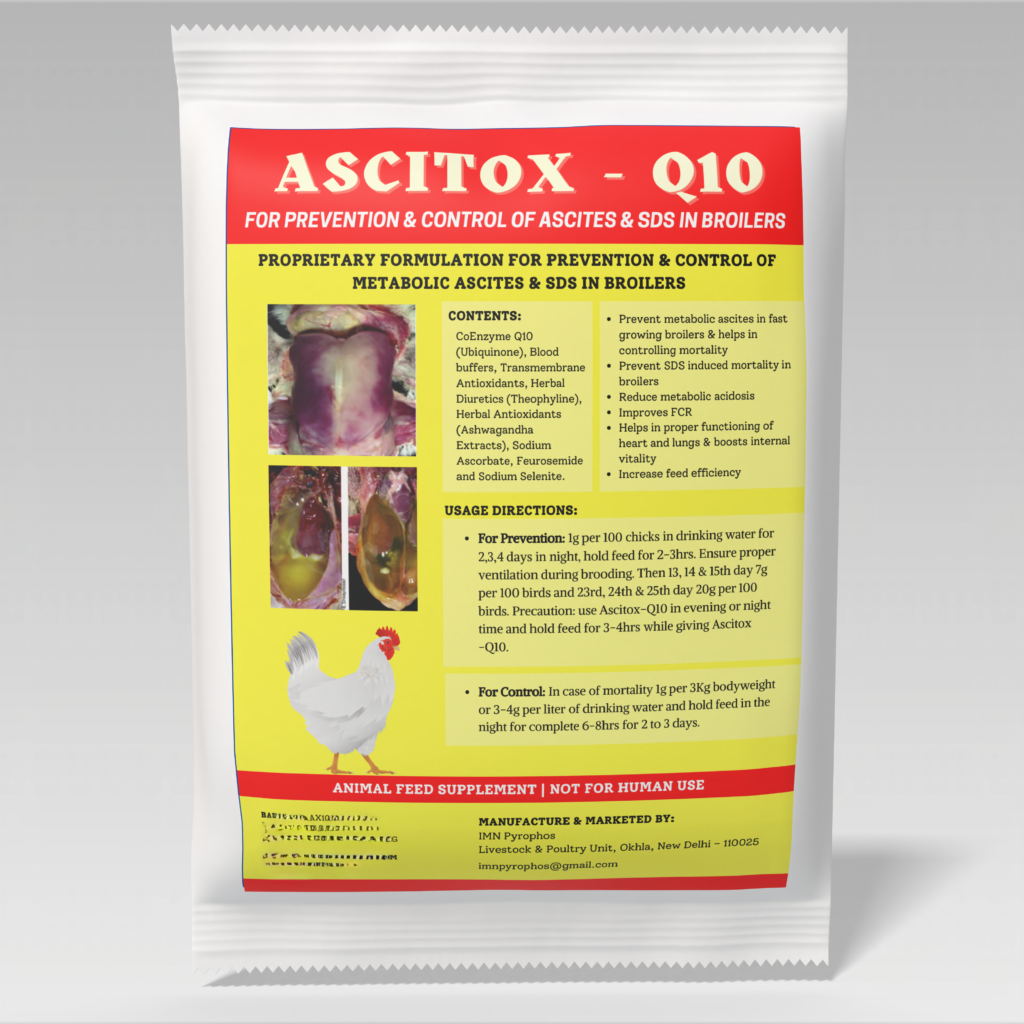
This article explains, in simple and practical language, a field-based research study conducted on commercial broiler farms during winter, focusing specifically on how ascites-related mortality changed when Ascitox was used as a nutritional intervention.
Wherever required, Roman Hindi explanations are included so that non-English readers can also follow the logic easily.
Read complete research article in this digital flip book and complete explanation in easy language below
Purpose of the Research: What Was Actually Being Tested
The research was not designed to “cure” ascites or eliminate mortality completely. The clear objective was to evaluate whether a metabolic and nutritional intervention (Ascitox-Q10) could reduce winter ascites–induced mortality and improve livability and performance under real commercial farm conditions.
Is research ka goal ye nahi tha ki ascites gayab ho jaaye, balki ye dekhna tha ki kya sahi nutritional support se deaths kam ki ja sakti hain ya nahi.
Study Design: Farms, Birds, and Winter Conditions
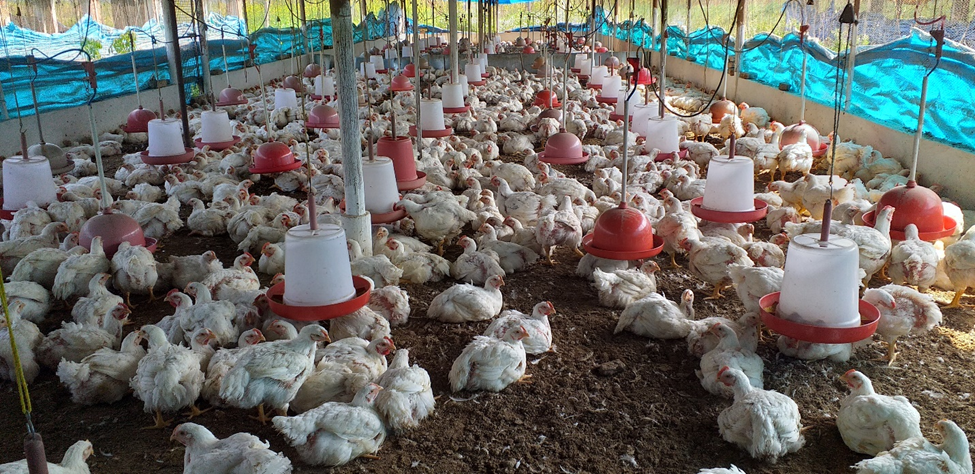
The study was conducted on nine commercial broiler farms located in the same eco-climatic zone in northern India during the winter season (November to February). Two commonly used commercial strains were involved—Cobb 430Y and Skylark Hubbard—managed under standard commercial conditions.
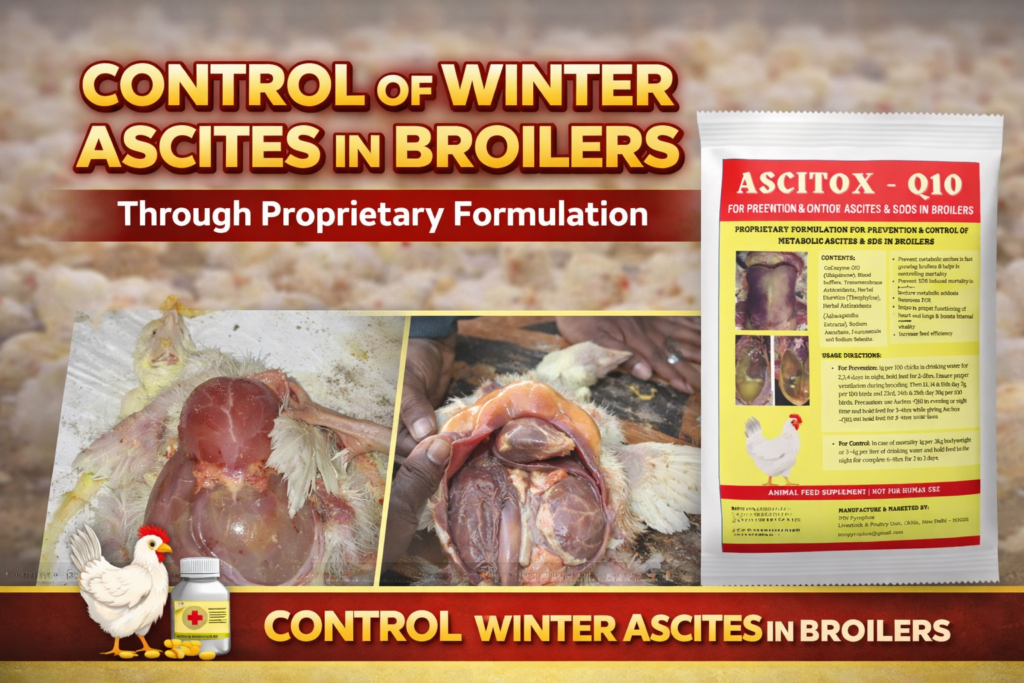
Some farms followed normal winter management only and served as the control group, while selected farms received Ascitox supplementation through drinking water at a rate of 4 g/L, administered on 2–3–4, 13–14–15, and 23–24–25 days of age.
Ascitox daily nahi diya gaya. Usey un dino me diya gaya jab metabolism aur stress peak par hota hai.
Why Mortality Was Divided into M1 and M2
One of the most important scientific strengths of this research was the classification of mortality into two stages:
- M1 mortality: deaths up to 15 days of age
- M2 mortality: deaths after 15 days of age
This division was based on the hypothesis that true ascites-related mortality occurs after 15 days, when growth rate, metabolic demand, and oxygen requirement increase sharply.
Ascites pehle din se nahi maarta, asli nuksaan teesre–chauthe hafte me hota hai.
Mortality Data: What Actually Changed with Ascitox
The mortality pattern observed during the study is summarized below.
Table 1. Mortality Pattern in Broiler Chickens
| Group | Farm Strength | M1 (%) | M2 (%) | Overall Mortality (%) |
|---|---|---|---|---|
| Control | 3068 | 3.22 | 4.15 | 7.24 |
| Ascitox | 2580 | 2.50 | 2.19 | 4.61 |
When this data is read carefully, several critical points emerge.
First, overall mortality reduced from 7.24% in control farms to 4.61% in Ascitox-supplemented farms, a statistically significant reduction. At commercial scale, this difference alone represents a major economic impact.
Sirf 2–3% kam mortality sunne me chhoti lagti hai, lekin commercial farm me ye bahut bada fark hota hai.
Where Ascitox Made the Biggest Difference: M2 Mortality
The most important observation comes from comparing M1 and M2 mortality.
Early mortality (M1) showed a modest reduction. However, late mortality (M2)—which represents true ascites-related deaths—dropped dramatically from 4.15% in control birds to 2.19% in Ascitox birds.
This tells us something very important:
Ascitox did not primarily act as a chick survival product. Its strongest effect was seen exactly at the stage when metabolic load and ascites pressure peak.
Ascitox ka kaam tab dikha jab ascites normally bird ko tod deta hai.
Strain Effect: Was the Response Genetics-Dependent?
The study also compared mortality patterns between the two broiler strains.
Table 2. Overall Mortality by Strain
| Strain | Overall Mortality (%) |
|---|---|
| Cobb 430Y | 5.90 |
| Skylark Hubbard | 5.93 |
There was no statistically significant difference between strains. This confirms that the effect observed was not strain-specific, but related to basic physiological mechanisms common to modern broilers.
Strain alag thi, result same tha — matlab product genetics nahi, system pe kaam kar raha hai.
Growth Performance Data: An Important Clarification
A common concern with ascites control strategies is that mortality reduction may occur simply because growth is suppressed. The performance data from this study clearly disproves that assumption.
Table 3. Growth Performance of Broiler Chickens
| Group | Average Weight (kg) | Feed Intake (kg) | FCR |
|---|---|---|---|
| Control | 2.12 | 3.84 | 1.81 |
| Ascitox | 2.29 | 3.71 | 1.62 |
Birds receiving Ascitox showed higher body weight, lower feed intake, and significantly improved FCR.
Bird ne kam khaya, lekin zyada weight banaya — ye growth suppression nahi, efficiency improvement hai.
This confirms that Ascitox did not reduce mortality by slowing growth, but by improving metabolic efficiency and physiological stability.
How Ascitox Reduced Mortality: What the Data and Discussion Indicate
The discussion section of the research links the observed reduction in M2 mortality to several interconnected physiological effects.
First, blood buffering and acid–base balance support improved blood pH, enhancing oxygen–hemoglobin binding capacity. This directly reduces pulmonary stress during high metabolic demand.
Second, antioxidant and mitochondrial support helped reduce oxidative stress in cardiac tissue. Since heart muscle is rich in mitochondria, protecting these structures improves pumping efficiency and delays cardiac failure.
Third, fluid and electrolyte regulation support reduced sodium and fluid retention, slowing the progression from pulmonary hypertension to abdominal fluid accumulation.
Ascitox ne paani nahi nikala, balki paani banne ka process slow kiya.
What This Research Proves—and What It Does Not
This study clearly demonstrates that winter ascites–induced mortality can be significantly reduced through targeted nutritional and metabolic intervention without compromising growth performance.
At the same time, the research does not claim:
- complete elimination of ascites
- instant cure of water belly
- replacement of good management or ventilation
Ye koi jaadu nahi, balki ek scientifically samjha hua support system hai.
Practical Takeaway
The most important takeaway from this research is that ascites is best controlled by stabilizing metabolism during high-risk phases, not by restricting growth or reacting after severe symptoms appear.
Ascitox, as shown in this study, works by reducing late-stage metabolic collapse, which is why its strongest impact appears in M2 mortality, not early chick losses.
Buy Ascitox Online Click Here 9871584101
ब्रॉयलर में Ascites (Water Belly) और Ascitox – शोध आधारित FAQs
FAQ 1: ब्रॉयलर में Ascites असल में क्या है, और यह सर्दियों में ज्यादा क्यों दिखता है?
ब्रॉयलर में Ascites, जिसे आम भाषा में Water Belly कहा जाता है, कोई साधारण बीमारी नहीं है। यह तब होता है जब पक्षी का शरीर तेज़ी से बढ़ता है, लेकिन दिल और फेफड़े उस ग्रोथ के हिसाब से ऑक्सीजन सप्लाई नहीं कर पाते।
सर्दियों में यह समस्या इसलिए ज्यादा दिखती है क्योंकि:
- शेड के परदे ज़्यादा बंद रहते हैं
- हवा का आवागमन कम हो जाता है
- ऑक्सीजन की मात्रा घट जाती है
- और पक्षी को शरीर गर्म रखने के लिए ज्यादा ऊर्जा खर्च करनी पड़ती है
Research में साफ देखा गया कि winter conditions ने metabolic stress को कई गुना बढ़ा दिया, जिससे ascites की घटनाएँ बढ़ीं।
FAQ 2: क्या Ascites कोई इंफेक्शन है? एंटीबायोटिक क्यों काम नहीं करते?
नहीं। Ascites किसी बैक्टीरिया या वायरस की वजह से नहीं होता।
यह एक metabolic और physiological failure है।
Research में जिन farms पर Ascitox नहीं दिया गया, वहाँ ascites mortality ज़्यादा थी, जबकि management और feed लगभग समान थे। इससे साफ साबित होता है कि:
- समस्या इंफेक्शन नहीं थी
- बल्कि अंदरूनी सिस्टम (metabolism, oxygen use, heart load) फेल हो रहा था
इसलिए एंटीबायोटिक देने से खर्च तो बढ़ता है, लेकिन ascites कंट्रोल नहीं होता।
FAQ 3: Research में Ascites को समझने के लिए mortality को M1 और M2 में क्यों बाँटा गया?
यह research का सबसे मजबूत scientific point है।
- M1 mortality (0–15 दिन):
यह आमतौर पर brooding issues, chick quality या शुरुआती stress से जुड़ी होती है। - M2 mortality (15 दिन के बाद):
यही असली ascites mortality होती है, जब bird का growth तेज़ होता है और metabolic load peak पर होता है।
Research में देखा गया कि:
- Ascitox का सबसे बड़ा असर M2 mortality पर पड़ा
- यानी Ascitox ने वहीं काम किया, जहाँ ascites वास्तव में मारता है
FAQ 4: Research में Ascitox से mortality में कितना फर्क पड़ा?
Research data के अनुसार:
- Control farms में कुल mortality: 7.24%
- Ascitox इस्तेमाल करने वाले farms में mortality: 4.61%
लेकिन असली फर्क तब दिखता है जब हम M2 mortality देखते हैं:
- Control farms में M2 mortality: 4.15%
- Ascitox farms में M2 mortality: 2.19%
यानी लगभग 50% तक late-stage mortality कम हुई।
सरल शब्दों में:
👉 Ascitox ने ascites से होने वाली मौतों को आधे से भी कम कर दिया।
FAQ 5: क्या Ascitox सिर्फ शुरुआती chicks को बचाता है?
नहीं। Research के अनुसार Ascitox का असर शुरुआती mortality (M1) पर थोड़ा था, लेकिन मुख्य असर late stage (M2) पर दिखा।
इसका मतलब:
- Ascitox chick booster नहीं है
- यह असली metabolic stress phase में काम करता है
Roman Hindi concept को हिंदी में समझें:
👉 जब bird का सिस्टम टूटने लगता है, Ascitox वहीं उसे संभालता है।
FAQ 6: क्या Ascitox देने से वजन या ग्रोथ कम हो जाती है?
यह एक बहुत बड़ा भ्रम है, जिसे research ने पूरी तरह तोड़ दिया।
Research data के अनुसार:
- Ascitox group का औसत वजन 2.29 kg था
- Control group का वजन 2.12 kg था
साथ ही:
- Feed intake कम रहा
- FCR बेहतर हुआ (1.62 vs 1.81)
इसका मतलब साफ है:
👉 Ascitox ने growth को रोका नहीं, बल्कि metabolic efficiency बढ़ाई।
FAQ 7: क्या Ascitox ascites को “ठीक” कर देता है या पानी निकाल देता है?
नहीं। Ascitox कोई diuretic नहीं है जो पेट का पानी निकाल दे।
Research से यह स्पष्ट है कि:
- Ascitox ने पानी निकालने की कोशिश नहीं की
- बल्कि उस प्रक्रिया को धीमा किया, जिसकी वजह से पानी बनता है
यानी:
👉 Ascitox symptom नहीं, cause पर काम करता है।
FAQ 8: Ascitox ने शरीर के अंदर ऐसा क्या बदला कि mortality कम हुई?
Research discussion के अनुसार Ascitox ने एक साथ कई systems को support किया:
- Blood का acid–base balance बेहतर हुआ
- Oxidative stress कम हुआ
- Heart की energy efficiency सुधरी
- Oxygen utilization बेहतर हुआ
- Fluid retention की गति कम हुई
इस multi-system support की वजह से:
👉 Bird metabolic collapse से बच पाया।
FAQ 9: क्या Ascitox का असर किसी खास strain में ही दिखा?
नहीं। Research में दो अलग strains (Cobb 430Y और Skylark Hubbard) शामिल थे।
Data से साफ दिखा कि:
- दोनों strains में mortality लगभग समान रही
- Ascitox का असर strain-specific नहीं था
इसका मतलब:
👉 Solution genetics पर नहीं, basic physiology पर काम कर रहा है।
FAQ 10: क्या Ascitox रोज़ाना देने वाला product है?
नहीं। Research में Ascitox:
- रोज़ नहीं
- बल्कि selected high-risk days पर दिया गया
यह दिखाता है कि Ascitox:
- Daily supplement नहीं
- बल्कि strategic metabolic support tool है
FAQ 11: क्या Ascitox management और ventilation का विकल्प बन सकता है?
बिल्कुल नहीं।
Research यह नहीं कहती कि:
- Ventilation की ज़रूरत खत्म हो जाती है
- या management ignore किया जा सकता है
Ascitox:
👉 अच्छे management के साथ मिलकर काम करता है, उसकी जगह नहीं लेता।
FAQ 12: Research के आधार पर किसान को सबसे बड़ी सीख क्या मिलती है?
सबसे बड़ी सीख यह है कि:
- Ascites अचानक नहीं होता
- यह अंदर से धीरे-धीरे बनता है
- और जब दिखता है, तब बहुत देर हो चुकी होती है
Research यह सिखाती है कि:
👉 Early metabolic support, late treatment से कहीं ज्यादा असरदार है।
अंतिम निष्कर्ष (Farmer के लिए सरल शब्दों में)
यह research साफ दिखाती है कि:
- Ascites को समझा जा सकता है
- Ascites को काफी हद तक कंट्रोल किया जा सकता है
- लेकिन इसके लिए बीमारी की तरह नहीं, system failure की तरह सोचना पड़ेगा
Ascitox इस research का practical outcome है —
कोई जादू नहीं, बल्कि data से निकला हुआ समाधान।
Call karein adhik jankari ke liye – 9871584101