
Layer Feed Formulation: How to Formulate Balanced Layer Feed (Phase-Wise Guide)
Introduction
Layer feed formulation plays a decisive role in determining body weight uniformity, egg size, shell quality, persistency of lay, and overall farm profitability. Improper nutrient balance at any stage—especially during rearing and pre-lay—can lead to early maturity, small egg size, weak shells, kidney stress, and poor peak production.
This article is written for commercial layer farmers, poultry nutritionists, feed mill operators, and consultants who want a science-based yet practical approach to layer feed formulation. It explains phase-wise nutrient requirements, the importance of body weight control, and provides a step-by-step example of BV300 pre-lay feed formulation.
Importance of Body Weight in Layer Nutrition
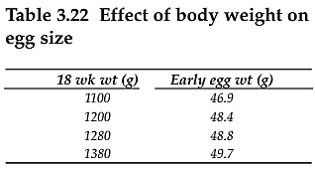
Pullets that reach target or slightly above-target body weight at sexual maturity consistently outperform underweight birds in terms of egg number and egg size.
Key points:
- Early maturity should be delayed, as it often results in small egg size
- Research by Summers and Leeson (1983) showed that body weight is the primary factor controlling early egg size
- Protein, methionine, and linoleic acid influence egg size throughout the laying cycle, but their effect on early egg size is limited
- Proper skeletal and frame development during rearing is essential for long-term production
👉 Therefore, rearing period nutrition is the foundation of layer performance.

Number of Feed Phases in the Layer Life Cycle
A commercial layer requires 6–7 different feed types throughout its life cycle:
- Chick Starter I
- Chick Starter II
- Grower / Developer
- Pre-Lay
- Layer Phase I
- Layer Phase II
Energy as the Driving Factor
- Layers primarily consume feed to meet their energy requirements
- All other nutrients must be balanced relative to dietary energy
- Birds adjust feed intake very precisely according to energy density
Rearing Period Nutrition (0–17 Weeks)
Chick Starter I (0–4 Weeks)
Objective
- Skeletal and organ development
- Feathering and skin condition
- Immune system activation
By 6 weeks of age, approximately 85% of skeletal development is already completed.
Nutrient Specifications
- Metabolizable Energy: 2860 kcal/kg
- Crude Protein: 18%
- Calcium: 1.2%
- Available Phosphorus: 0.48%
- Digestible Lysine: 0.89%
- Digestible Methionine + Cystine: 0.67%
- Linoleic Acid: 1.2%
Target body weight: ~230 g
Feed intake: ~490 g/bird
Double-crumble pellets (3 mm) give superior early growth results.

Chick Starter II (5–9 Weeks)
Starter II feed is approximately 5% less expensive than Starter I and supports steady frame development.
- Metabolizable Energy: 2800 kcal/kg
- Crude Protein: 17%
- Calcium: 1.2%
- Available Phosphorus: 0.46%
Target body weight: ~670 g
Feed intake: ~1512 g/bird
Grower / Developer Feed (10–15 Weeks)
This phase accounts for nearly 44% of total rearing feed and is crucial for frame and digestive system development.
- Metabolizable Energy: 2685 kcal/kg
- Crude Protein: 15.7%
- Calcium: 1.2%
- Crude Fibre: 5–6% (beneficial)
Target body weight: ~1090 g
Feed intake: ~2303 g/bird
Increased fibre and appropriate particle size support gizzard development.
Pre-Lay Nutrition (16–17 Weeks)
The pre-lay diet prepares the bird for calcium metabolism and eggshell formation.
Key characteristics
- Higher calcium than developer feed
- Slightly increased protein and amino acids
Nutrient Specifications
- Metabolizable Energy: 2680 kcal/kg
- Crude Protein: 16%
- Calcium: 2.5%
- Available Phosphorus: 0.42%
Feeding duration
- Start two weeks before onset of lay
- Visible signs include comb enlargement and reddening
⚠️ The pre-lay diet must be withdrawn no later than 0.5% hen-day production, as its calcium level is insufficient for sustained egg production.

Layer Production Phase Nutrition
Layer Phase I (0.5% HDP to 40 Weeks)
- Metabolizable Energy: 2550 kcal/kg
- Crude Protein: 14–15.5%
- Calcium: 3.9%
- Average feed intake: ~110 g/bird/day
A daily intake of ~670 mg digestible lysine is recommended for optimal performance.
Layer Phase II (Above 41 Weeks)
- Metabolizable Energy: 2550 kcal/kg
- Crude Protein: 13.7–15%
- Calcium: 4.0%
Calcium levels are slightly increased to maintain shell quality during late lay.
Practical Feeding Guidelines
- Change diets based on target body weight, not age alone
- Feed pre-lay diet strictly for two weeks only
- At least 50% of calcium carbonate should be coarse (≈2 mm)
- Maximum chloride level should not exceed 0.24%
- Choline is best added directly into the mixer due to its hygroscopic nature
Example: BV300 Pre-Lay Feed Formulation (1000 kg)
Nutrient Targets
- Crude Protein: 16%
- Metabolizable Energy: 2680 kcal/kg
- Calcium: 2.5%
- Available Phosphorus: 0.42%
- Methionine: 0.57%
- Lysine: 0.7%
- Linoleic Acid: 1.2%
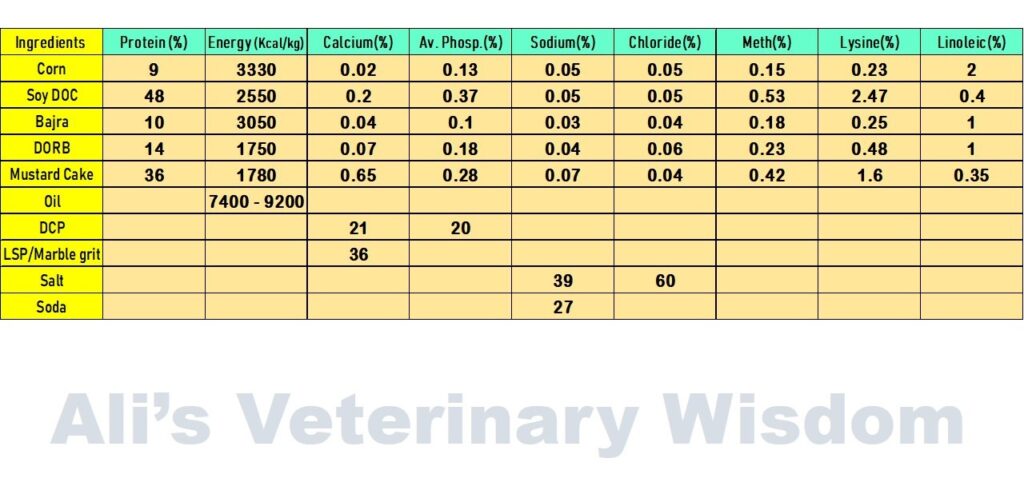
Final Ingredient Composition
- Maize – 447.07 kg
- Soybean DOC – 149.92 kg
- Bajra – 200 kg
- Mustard Cake – 50 kg
- DORB – 70 kg
- DCP – 13 kg
- Limestone Powder – 59 kg
- Salt – 1.8 kg
- Sodium Bicarbonate – 3.15 kg
- Aviyora amino acids premix – 2kg
Premix and Additives (5.2 kg)
- VitADEN Vitamin Premix – 0.5 kg
- Pyromin Minerals – 0.75 kg
- Toxtrap (Toxin Binder) – 1.0 kg
- Enzyme – 0.4 kg
- Probiotic – 0.2 kg
- Phytase – 0.1 kg
- Choline Chloride – 1.0 kg
✅ Final feed weight ≈ 1000 kg
Common Mistakes in Layer Feed Formulation
- Skipping the pre-lay diet
- Excessive calcium inclusion too early
- Changing feed based on age instead of body weight
- Ignoring particle size and grit requirement
- Underestimating choline and electrolyte balance
Frequently Asked Questions (FAQ)
Q1. Why is energy the most critical factor in layer feed formulation?
Because layers regulate feed intake based on energy density; all other nutrients must align with energy intake.
Q2. How long should pre-lay feed be given?
Approximately 14 days before onset of egg production.
Q3. Can excessive calcium harm young layers?
Yes, early high calcium intake increases kidney load and may depress early production.
Q4. Is the same feed formula suitable for all layer strains?
The basic structure is similar, but minor nutrient adjustments are required for different genetic lines.
Q5. What happens if layer body weight is below target at point of lay?
Underweight pullets usually start laying smaller eggs, show poor peak production, and fail to sustain long laying cycles. Feed intake and nutrient utilization also remain suboptimal.
Q6. Can layer feed formulation be adjusted during extreme summer or winter?
Yes. During heat stress, energy density may be increased slightly using oil, while maintaining amino acid balance. Electrolyte balance and vitamin supplementation become critical.
Q7. Is maize compulsory in layer feed formulation?
No. Maize can be partially replaced with alternatives like wheat, sorghum, bajra, or broken rice, provided energy and amino acid balance is maintained.
Q8. Why is particle size important in layer feed?
Proper particle size improves gizzard development, digestion efficiency, and calcium utilization, ultimately improving egg shell quality and feed conversion.
Q9. Should antibiotics be used in layer feed formulation?
Routine antibiotic use is not recommended. Good biosecurity, balanced nutrition, probiotics, and enzymes are more sustainable and safer alternatives.
Q10. What is the role of linoleic acid in layer diets?
Linoleic acid influences egg size and egg mass output. Deficiency can result in reduced egg weight, especially during early lay.
Q11. Can the same formulation be used for brown-egg and white-egg layers?
The general formulation is similar, but brown-egg layers often require slightly higher body weight targets and calcium intake.
Q12. How often should layer feed formulations be reviewed?
Feed formulations should be reviewed whenever ingredient prices change, seasonal stress occurs, or performance deviates from breed standards.
Layer farming में सफल उत्पादन के लिए feed formulation सबसे महत्वपूर्ण आधार है। सही तरीके से तैयार किया गया balanced feed न केवल bodyweight को target पर लाता है, बल्कि egg size, shell quality, peak production और flock की longevity को भी बेहतर बनाता है। अक्सर देखा जाता है कि किसान केवल protein प्रतिशत पर ध्यान देते हैं, जबकि वास्तव में energy सबसे प्रमुख nutrient होती है। Layer पक्षी अपनी energy आवश्यकता के अनुसार feed intake को स्वयं नियंत्रित करती हैं, इसलिए सभी nutrients को energy के अनुसार संतुलित करना आवश्यक होता है।
Layer birds के पूरे जीवनकाल में लगभग 6 से 7 प्रकार की feed की आवश्यकता होती है, जिनमें chick starter, grower, pre-lay और production phase feeds शामिल हैं। Rearing period (0–17 सप्ताह) सबसे ज्यादा निर्णायक होता है क्योंकि इसी समय skeleton, frame और digestive system का विकास होता है। लगभग 6 सप्ताह की उम्र तक 85% skeletal development पूरा हो चुका होता है, इसलिए starter और grower feed में amino acids, minerals और vitamins का सही संतुलन बेहद जरूरी है।
Pre-lay feed एक transitional feed होती है, जो egg production से लगभग 2 सप्ताह पहले दी जाती है। इसमें calcium की मात्रा grower feed से अधिक होती है ताकि पक्षी का शरीर आने वाली egg shell formation के लिए तैयार हो सके। यदि pre-lay feed को skip किया जाए या गलत समय तक दिया जाए, तो shell quality खराब हो सकती है या kidney पर अतिरिक्त दबाव पड़ सकता है।
Production phase में calcium, phosphorus और amino acids का संतुलन बनाए रखना अत्यंत आवश्यक है। Phase-I में egg production और egg mass सबसे अधिक होता है, जबकि Phase-II में shell quality बनाए रखना मुख्य उद्देश्य होता है। Calcium का कुछ हिस्सा coarse particle (लगभग 2 mm) में देना gizzard development और calcium utilization के लिए लाभकारी होता है।
Layer feed formulation में एक बड़ी गलती यह होती है कि feed change केवल उम्र के आधार पर कर दिया जाता है। वास्तव में feed हमेशा target bodyweight और production level के अनुसार बदलनी चाहिए। इसके अलावा, अनावश्यक antibiotics का प्रयोग करने के बजाय biosecurity, probiotics, enzymes और balanced nutrition पर ध्यान देना अधिक सुरक्षित और sustainable तरीका है।
संक्षेप में, सही layer feed formulation से:
- Bodyweight uniform रहता है
- Egg size और shell quality बेहतर होती है
- Peak production लंबा चलता है
- Feed cost और production cost दोनों नियंत्रित रहते हैं

Fazilka near pak border. Feed only 35% m cheaks hatch karnna hi extra kya dala jay ki hatch ablty good rahi please hallap me m I m. n pyropas ki dawai us karta hu
Egg Up aur Sel e boost subh ke samay, pyrocalB sham ke samay