

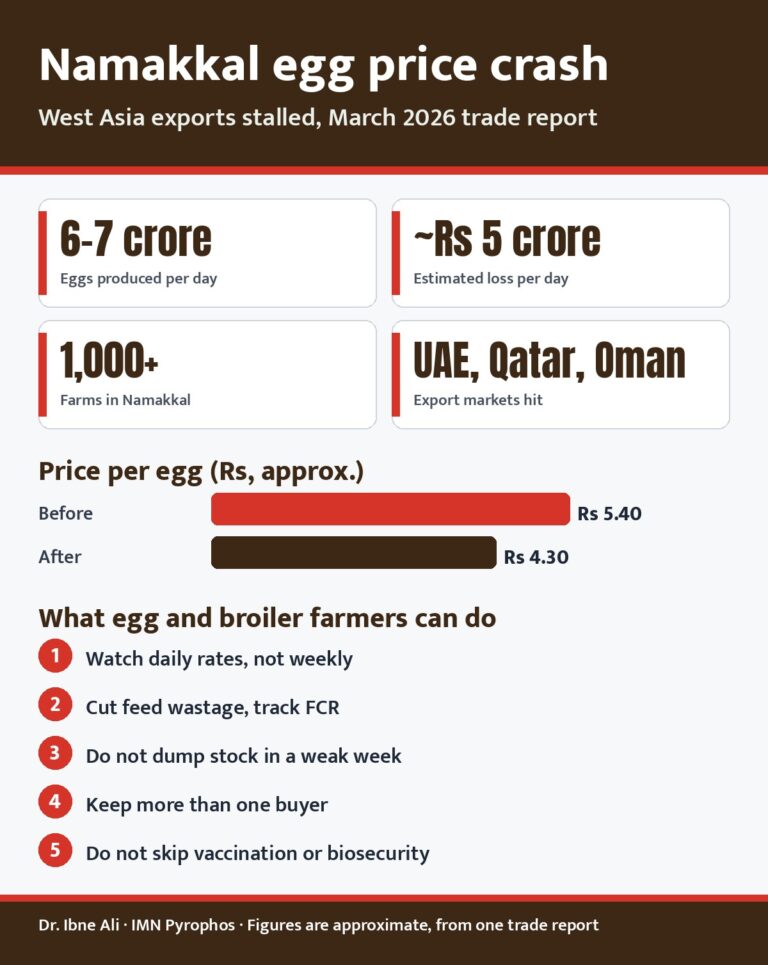
In March 2026, egg exports from Namakkal, known as the “Egg City of India”, to West Asian countries stalled after conflict-linked disruption of shipping routes, and egg prices in Namakkal fell sharply. Industry reports at the time put the cluster’s loss at nearly Rs 5 crore a day. The report we used is dated 27 March 2026, so this is an explainer on what happened and what it teaches, not breaking news. We could not confirm today’s Namakkal rate from that report; please check current rates before you decide anything.
Key facts (as reported in March 2026)
| Item | Detail |
|---|---|
| Where | Namakkal, Tamil Nadu, with more than 1,000 farms plus hatcheries, feed mills and exporters |
| Output | More than 6 to 7 crore (60 to 70 million) eggs per day |
| Export markets hit | UAE, Qatar and Oman |
| Cause | Geopolitical tension disrupted shipping routes and exporters paused operations |
| Estimated loss | Nearly Rs 5 crore per day for the cluster |
| Price move | From about Rs 5.40 to about Rs 4.30 per egg; NECC cut its benchmark more than once |
| Extra pressure | Weak summer demand, further dip during Ramzan and Lent |
| Industry ask | New export markets, logistics help and measures to absorb surplus eggs at home |
The exact figures above come from one trade report and are approximate. Farm-gate rates differ by town and day.
Why exports matter for egg prices
An egg cluster that produces crores of eggs a day needs steady buyers. Exports act like a pressure valve: when overseas orders move a part of the production out of the country, the domestic market stays balanced. When that valve closes suddenly, the same eggs stay in India. Cold rooms and egg trays fill up, traders offer lower rates, and the producer has to accept them because eggs cannot be stored for long.
Layers do not stop laying when the price falls. A farm cannot switch production off for a month, so supply stays high while demand is weak. This is why a modest-looking fall per egg can turn into a heavy daily loss across a large cluster.
What it means for farmers
- Layer farmers: feed cost is fixed per bird per day, so every rupee lost on the egg price comes straight out of margin. Small and mid-sized farms with little cash reserve feel it first.
- Broiler farmers: eggs and chicken compete for the same consumer spend. Weak egg prices can also push some farmers to cull or sell birds early, which adds supply to the meat market. Keep an eye on broiler rates when egg rates fall.
- Everyone in the chain: feed dealers, transporters and tray suppliers depend on the same farms, so a price crisis spreads through the local economy.
What farmers should do
- Watch daily rates, not weekly. Track the benchmark and your local mandi every day. See our daily rate page for the latest figures.
- Control cost per egg or per kg of meat. Feed is the biggest cost, so reduce wastage, keep feeders at the right height and track FCR with our CFCR calculator.
- Plan sale timing. Where you can, avoid dumping stock in a weak week. Do not hold birds past their economic age hoping for a rebound, because extra feed costs more than the possible gain.
- Do not stretch flock size on a good month. Expand step by step so that one bad quarter does not break the farm.
- Look for more than one buyer. Traders, retailers, hotels and bakeries in nearby towns can reduce dependence on a single channel.
- Keep health and production steady. Low prices are not the time to skip vaccination, biosecurity or a good mineral and vitamin programme, because a drop in egg quality or flock health costs more later.
- Keep a cash cushion for a few weeks of feed, and talk to your feed dealer early rather than late if payments will be delayed.
Frequently asked questions
Why did Namakkal egg prices fall in March 2026?
Reports said exports to West Asia stopped because shipping routes were disrupted, so eggs meant for export entered the Indian market. Weak summer demand and the Ramzan and Lent period added to the oversupply.
How much did the price fall?
The report mentions a fall from about Rs 5.40 to about Rs 4.30 per egg in Namakkal, with some farmers getting less in certain markets.
Are egg prices still low today?
We do not know from that report. It expected recovery once exports resumed and demand stabilised, but rates change daily, so check the current NECC and mandi rates.
Written by the IMN Pyrophos team in our own words.
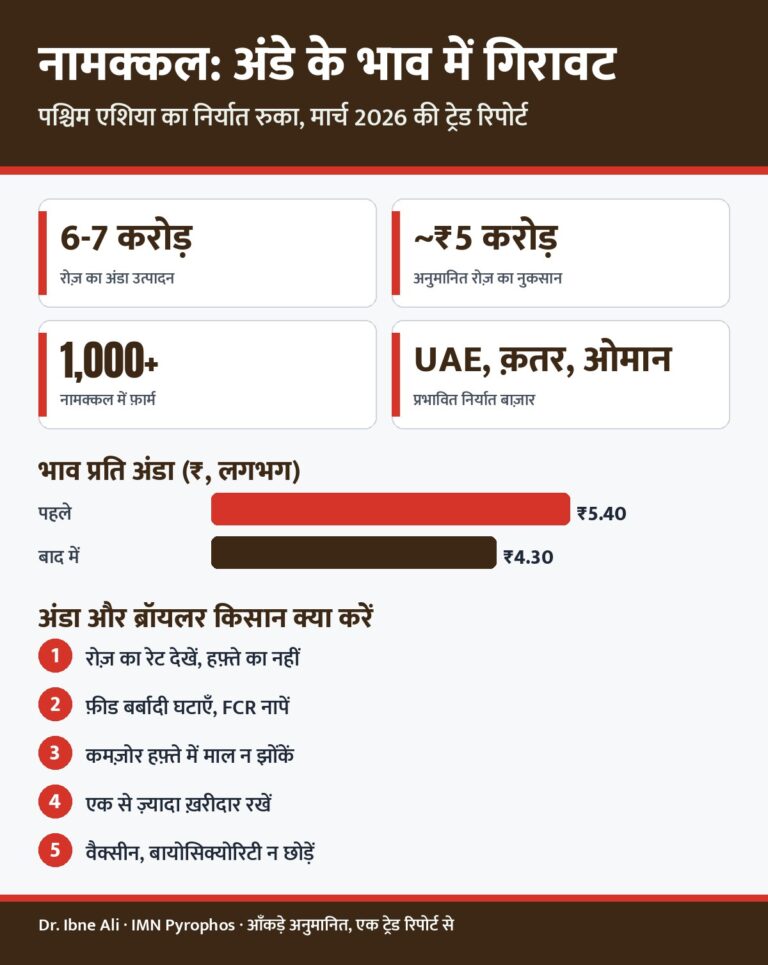
मार्च 2026 में भारत के “एग सिटी” नामक्कल से पश्चिम एशिया के देशों को अंडा निर्यात रुक गया, क्योंकि संघर्ष के कारण समुद्री मार्ग बाधित हो गए, और नामक्कल में अंडे के भाव तेज़ी से गिरे। उस समय की इंडस्ट्री रिपोर्टों में पूरे क्लस्टर का नुकसान लगभग ₹5 करोड़ रोज़ बताया गया। हमारी रिपोर्ट 27 मार्च 2026 की है, इसलिए यह ताज़ा ख़बर नहीं बल्कि समझाने वाला लेख है कि क्या हुआ और उससे क्या सीख मिलती है। उस रिपोर्ट से हम आज का नामक्कल भाव पक्का नहीं कर सकते; कोई भी फ़ैसला लेने से पहले मौजूदा रेट ज़रूर देखें।
मुख्य तथ्य (मार्च 2026 की रिपोर्ट के अनुसार)
| बिंदु | विवरण |
|---|---|
| कहाँ | नामक्कल, तमिलनाडु; 1,000 से ज़्यादा फ़ार्म, साथ में हैचरी, फ़ीड मिल और निर्यातक |
| उत्पादन | रोज़ 6 से 7 करोड़ (60 से 70 मिलियन) से ज़्यादा अंडे |
| प्रभावित निर्यात बाज़ार | UAE, क़तर और ओमान |
| कारण | भू-राजनीतिक तनाव से शिपिंग मार्ग बाधित हुए और निर्यातकों ने काम रोका |
| अनुमानित नुकसान | क्लस्टर का लगभग ₹5 करोड़ प्रति दिन |
| भाव में बदलाव | लगभग ₹5.40 से लगभग ₹4.30 प्रति अंडा; NECC ने बेंचमार्क कई बार घटाया |
| अतिरिक्त दबाव | गर्मी में कमज़ोर माँग, रमज़ान और लेंट में और गिरावट |
| इंडस्ट्री की माँग | नए निर्यात बाज़ार, लॉजिस्टिक मदद और ज़्यादा अंडों को घरेलू बाज़ार में खपाने के उपाय |
ऊपर के आँकड़े एक ट्रेड रिपोर्ट से हैं और अनुमानित हैं। फ़ार्म-गेट भाव शहर और दिन के हिसाब से बदलते हैं।
अंडे के भाव के लिए निर्यात क्यों मायने रखता है
जिस क्लस्टर में रोज़ करोड़ों अंडे बनते हों, उसे लगातार ख़रीदार चाहिए। निर्यात एक प्रेशर वाल्व की तरह काम करता है: विदेश के ऑर्डर उत्पादन का एक हिस्सा देश से बाहर ले जाते हैं तो घरेलू बाज़ार संतुलित रहता है। यह वाल्व अचानक बंद हो जाए तो वही अंडे भारत में रह जाते हैं। कोल्ड रूम और ट्रे भर जाती हैं, व्यापारी कम रेट बोलते हैं, और अंडे ज़्यादा दिन रखे नहीं जा सकते, इसलिए उत्पादक को वही रेट मानना पड़ता है।
भाव गिरने पर लेयर अंडे देना बंद नहीं करतीं। फ़ार्म एक महीने के लिए उत्पादन बंद नहीं कर सकता, इसलिए सप्लाई ऊँची रहती है और माँग कमज़ोर। इसी वजह से प्रति अंडा मामूली दिखने वाली गिरावट बड़े क्लस्टर में भारी रोज़ाना नुकसान बन जाती है।
किसानों के लिए इसका मतलब
- लेयर किसान: फ़ीड की लागत प्रति पक्षी प्रति दिन तय रहती है, इसलिए अंडे के भाव में गिरा हर रुपया सीधे मार्जिन से कटता है। कम नकदी वाले छोटे और मध्यम फ़ार्म पर सबसे पहले असर पड़ता है।
- ब्रॉयलर किसान: अंडा और चिकन एक ही उपभोक्ता बजट के लिए होड़ करते हैं। अंडे के कमज़ोर भाव से कुछ किसान पक्षी जल्दी बेच या कल्ल कर सकते हैं, जिससे मीट बाज़ार में सप्लाई बढ़ती है। अंडे के भाव गिरें तो ब्रॉयलर रेट पर नज़र रखें।
- पूरी चेन: फ़ीड डीलर, ट्रांसपोर्टर और ट्रे सप्लायर इन्हीं फ़ार्मों पर निर्भर हैं, इसलिए भाव का संकट पूरे स्थानीय कारोबार में फैलता है।
किसान क्या करें
- हफ़्ते में नहीं, रोज़ भाव देखें। बेंचमार्क और अपनी स्थानीय मंडी का रेट रोज़ देखें। ताज़ा भाव के लिए हमारा रोज़ का रेट पेज देखें।
- प्रति अंडा या प्रति किलो मीट की लागत घटाएँ। फ़ीड सबसे बड़ा ख़र्च है, इसलिए बर्बादी घटाएँ, फ़ीडर सही ऊँचाई पर रखें और हमारे CFCR कैलकुलेटर से FCR नापें।
- बिक्री का समय सोचें। जहाँ संभव हो, कमज़ोर हफ़्ते में माल न झोंकें। भाव सुधरने की उम्मीद में पक्षियों को आर्थिक उम्र से ज़्यादा न रखें, क्योंकि अतिरिक्त फ़ीड का ख़र्च संभावित फ़ायदे से ज़्यादा होता है।
- अच्छे महीने में झुंड ज़्यादा न बढ़ाएँ। धीरे-धीरे बढ़ाएँ ताकि एक बुरी तिमाही से फ़ार्म न टूटे।
- एक से ज़्यादा ख़रीदार ढूँढें। आसपास के शहरों के व्यापारी, रिटेलर, होटल और बेकरी एक ही चैनल पर निर्भरता घटाते हैं।
- स्वास्थ्य और उत्पादन स्थिर रखें। कम भाव के समय वैक्सीनेशन, बायोसिक्योरिटी और अच्छा मिनरल-विटामिन प्रोग्राम न छोड़ें, क्योंकि अंडे की क्वालिटी या झुंड का स्वास्थ्य गिरना बाद में ज़्यादा महँगा पड़ता है।
- कुछ हफ़्ते के फ़ीड जितनी नकदी रखें और भुगतान में देरी हो तो फ़ीड डीलर से पहले बात करें।
अक्सर पूछे जाने वाले सवाल
मार्च 2026 में नामक्कल में अंडे के भाव क्यों गिरे?
रिपोर्टों के अनुसार शिपिंग मार्ग बाधित होने से पश्चिम एशिया को निर्यात रुक गया, इसलिए निर्यात के अंडे भारतीय बाज़ार में आ गए। गर्मी की कमज़ोर माँग और रमज़ान-लेंट ने ओवरसप्लाई बढ़ाई।
भाव कितना गिरा?
रिपोर्ट में नामक्कल में लगभग ₹5.40 से लगभग ₹4.30 प्रति अंडा गिरावट का ज़िक्र है, और कुछ बाज़ारों में किसानों को इससे भी कम मिला।
क्या आज भी अंडे के भाव कम हैं?
उस रिपोर्ट से हमें नहीं पता। उसमें निर्यात शुरू होने और माँग स्थिर होने पर सुधार की उम्मीद थी, पर भाव रोज़ बदलते हैं, इसलिए मौजूदा NECC और मंडी रेट देखें।
IMN Pyrophos टीम द्वारा हमारे अपने शब्दों में लिखा गया।
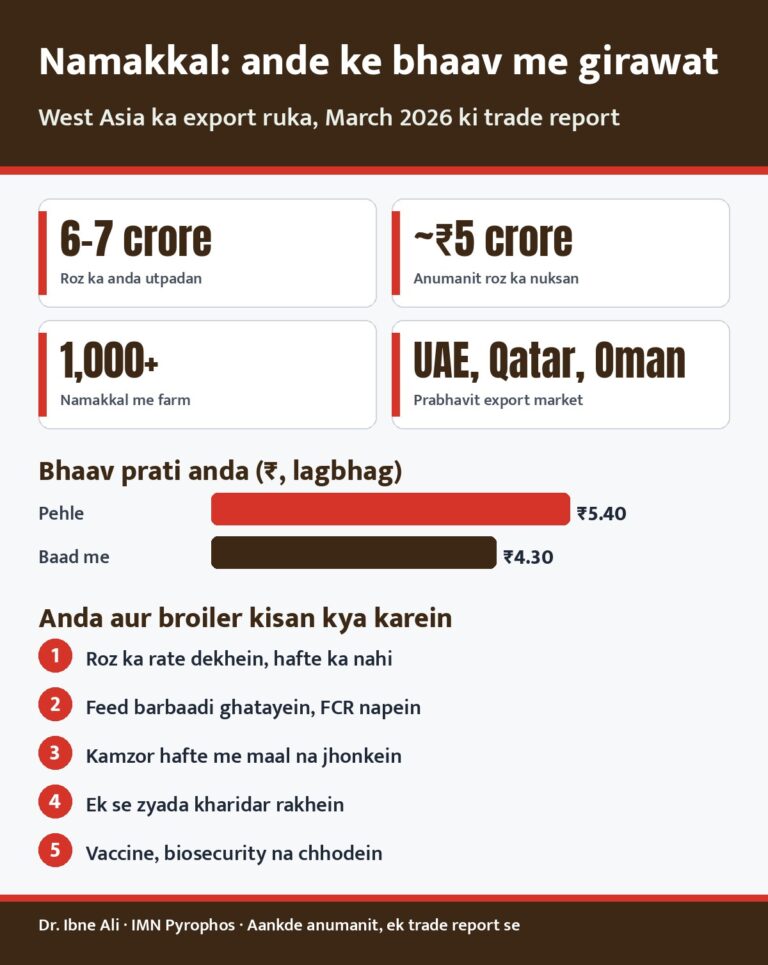
March 2026 me Bharat ke “Egg City” Namakkal se West Asia ke deshon ko anda export ruk gaya, kyunki sangharsh ke karan samudri marg badhit ho gaye, aur Namakkal me ande ke bhaav tezi se gire. Us samay ki industry reports me poore cluster ka nuksan lagbhag ₹5 crore roz bataya gaya. Hamari report 27 March 2026 ki hai, isliye ye taaza khabar nahi balki samjhane wala lekh hai ki kya hua aur usse kya seekh milti hai. Us report se hum aaj ka Namakkal bhaav pakka nahi kar sakte; koi bhi faisla lene se pehle maujooda rate zaroor dekhein.
Mukhya tathya (March 2026 ki report ke anusaar)
| Bindu | Vivaran |
|---|---|
| Kahan | Namakkal, Tamil Nadu; 1,000 se zyada farm, saath me hatchery, feed mill aur niryatak |
| Utpadan | Roz 6 se 7 crore (60 se 70 million) se zyada ande |
| Prabhavit export market | UAE, Qatar aur Oman |
| Karan | Bhu-rajneetik tanav se shipping marg badhit hue aur niryatakon ne kaam roka |
| Anumanit nuksan | Cluster ka lagbhag ₹5 crore prati din |
| Bhaav me badlav | Lagbhag ₹5.40 se lagbhag ₹4.30 prati anda; NECC ne benchmark kai baar ghataya |
| Atirikt dabav | Garmi me kamzor maang, Ramzan aur Lent me aur girawat |
| Industry ki maang | Naye export market, logistics madad aur zyada ande ghar ke bazaar me khapane ke upay |
Upar ke aankde ek trade report se hain aur anumanit hain. Farm-gate bhaav shehar aur din ke hisaab se badalte hain.
Ande ke bhaav ke liye export kyon mayne rakhta hai
Jis cluster me roz crore ande bante hon, use lagataar kharidar chahiye. Export ek pressure valve ki tarah kaam karta hai: videsh ke order utpadan ka ek hissa desh se bahar le jaate hain to gharelu bazaar santulit rehta hai. Ye valve achanak band ho jaye to wahi ande Bharat me reh jaate hain. Cold room aur tray bhar jaati hain, vyapari kam rate bolte hain, aur ande zyada din rakhe nahi ja sakte, isliye utpadak ko wahi rate maanna padta hai.
Bhaav girne par layer ande dena band nahi kartin. Farm ek mahine ke liye utpadan band nahi kar sakta, isliye supply oonchi rehti hai aur maang kamzor. Isi wajah se prati anda maamooli dikhne wali girawat bade cluster me bhaari rozana nuksan ban jaati hai.
Kisanon ke liye iska matlab
- Layer kisan: feed ki lagat prati pakshi prati din tay rehti hai, isliye ande ke bhaav me gira har rupaya seedha margin se katta hai. Kam nakdi wale chhote aur madhyam farm par sabse pehle asar padta hai.
- Broiler kisan: anda aur chicken ek hi upbhokta budget ke liye hod karte hain. Ande ke kamzor bhaav se kuch kisan pakshi jaldi bech ya cull kar sakte hain, jisse meat bazaar me supply badhti hai. Ande ke bhaav girein to broiler rate par nazar rakhein.
- Poori chain: feed dealer, transporter aur tray supplier inhi farmon par nirbhar hain, isliye bhaav ka sankat poore sthaniya karobar me phailta hai.
Kisan kya karein
- Hafte me nahi, roz bhaav dekhein. Benchmark aur apni sthaniya mandi ka rate roz dekhein. Taaza bhaav ke liye hamara roz ka rate page dekhein.
- Prati anda ya prati kilo meat ki lagat ghatayein. Feed sabse bada kharch hai, isliye barbaadi ghatayein, feeder sahi oonchai par rakhein aur hamare CFCR calculator se FCR napein.
- Bikri ka samay sochein. Jahan sambhav ho, kamzor hafte me maal na jhonkein. Bhaav sudharne ki ummeed me pakshiyon ko economic umar se zyada na rakhein, kyonki atirikt feed ka kharch sambhavit fayde se zyada hota hai.
- Achhe mahine me jhund zyada na badhayein. Dheere-dheere badhayein taaki ek buri timahi se farm na toote.
- Ek se zyada kharidar dhundhein. Aaspaas ke shehron ke vyapari, retailer, hotel aur bakery ek hi channel par nirbharta ghatate hain.
- Swasthya aur utpadan sthir rakhein. Kam bhaav ke samay vaccination, biosecurity aur achha mineral-vitamin program na chhodein, kyonki ande ki quality ya jhund ka swasthya girna baad me zyada mehnga padta hai.
- Kuch hafte ke feed jitni nakdi rakhein aur bhugtan me deri ho to feed dealer se pehle baat karein.
Aksar puchhe jaane wale sawal
March 2026 me Namakkal me ande ke bhaav kyon gire?
Reports ke anusaar shipping marg badhit hone se West Asia ko export ruk gaya, isliye export ke ande Bharatiya bazaar me aa gaye. Garmi ki kamzor maang aur Ramzan-Lent ne oversupply badhayi.
Bhaav kitna gira?
Report me Namakkal me lagbhag ₹5.40 se lagbhag ₹4.30 prati anda girawat ka zikr hai, aur kuch bazaaron me kisanon ko isse bhi kam mila.
Kya aaj bhi ande ke bhaav kam hain?
Us report se hamein nahi pata. Usme export shuru hone aur maang sthir hone par sudhar ki ummeed thi, par bhaav roz badalte hain, isliye maujooda NECC aur mandi rate dekhein.
IMN Pyrophos team dwara hamare apne shabdon me likha gaya.