
Poultry Flies Problem
Fly control in Poultry Farm should be an important part of every poultry farm’s management. Flies spread diseases and dirt, disturb workers, and create problems for nearby farms and residential areas. As small farms decrease and large poultry farms grow bigger, flies gather in one place more easily, making the problem more serious.
There are many types of flies on poultry farms, but the most common are the little house fly (Fannia) and the house fly (Musca domestica). Other flies like soldier flies, blow flies, black garbage flies, and stable flies may also be present, but they are usually not included in control programs.
The little house fly is smaller than the house fly, but it is hard to tell the difference. These flies prefer dry breeding places and especially like poultry manure. They stay in cool and shady areas and are often seen flying in circles under hanging objects in poultry houses, egg rooms, and feed rooms. They do not sit much on humans or food, but they cause complaints from nearby residents because they gather in large numbers in homes, garages, and shaded areas.
The house fly has different habits. It breeds in all kinds of organic materials like decaying plants, spilled feed, and animal manure. In caged layer houses, manure becomes a perfect breeding place, especially when hygiene is poor and water leakage makes it wet. These flies like sunlight and are very active. They sit on dirt, humans, and food, which makes them very important in spreading diseases. They also leave spots on eggs.
The best way to control flies is proper manure management. Flies go through four life stages: egg, larva (maggot), pupa, and adult. Eggs are laid in manure, and larvae grow in moist conditions. Pupae develop in drier places. Fresh poultry manure has about 60–80% moisture, but if it is reduced to around 30%, it becomes unsuitable for flies. Another method is to make manure fully liquid so flies are not attracted.
Dry manure management has many benefits. It is easier to handle, has less volume, and produces less smell. There are three main methods. The first is the litter-based floor system, where litter is kept dry to reduce flies. The second is frequent cleaning in caged systems, usually every week, where fresh manure is removed and spread on land to dry quickly and stop the breeding cycle. However, even a small amount of leftover manure can become a breeding site.
The third method is the deep storage system, where manure is stored under cages for a long time. In this system, fly problems are less because manure stays dry, the area is dark, and natural predators are present. Composting also takes place, which reduces volume and allows longer storage.
In all these systems, moisture control is the most important factor. Water leakage is a major problem, especially from drinkers. Proper drainage is also needed to stop outside water from entering. The area around the poultry house should have a proper slope to prevent rainwater from coming inside and wetting the manure.
Ventilation also plays an important role. Fresh air removes moisture, keeps birds comfortable, and helps manure stay dry. Other helpful practices include keeping the watering system clean, avoiding high-salt diets (as they increase water intake), and maintaining proper temperature inside the house.
In mechanical control, the first step is to stop flies from entering. Screens can be used on doors, windows, and curtains. Flies inside can be controlled with electric insect traps and bait stations. These traps attract flies with light and kill them using electricity. These methods work best along with good cleanliness.
Chemical control should be the last option, used only when management and cleaning methods fail. Only approved insecticides should be used, and instructions must be followed carefully. Methods include residual sprays, space sprays, vapor strips, fly baits, and larvicides. Residual sprays are applied in specific areas and can control flies for up to four weeks.
Space sprays or mists are used when there are too many adult flies and quick control is needed. Bait stations contain insecticide and attractants like sugar, but they should be used along with other methods and kept away from birds. Vapor strips work in closed spaces but are not suitable for poultry houses due to high ventilation.
Larvicides are also important. One type is sprayed on manure to kill larvae, but its effect may reduce when fresh manure is added. It can also cause resistance and harm useful insects. Another type is feed-through larvicide, such as Larvadex, which is given through feed and works in manure. It is allowed only for caged layers and must be used carefully with proper guidelines. Continuous use is not recommended.
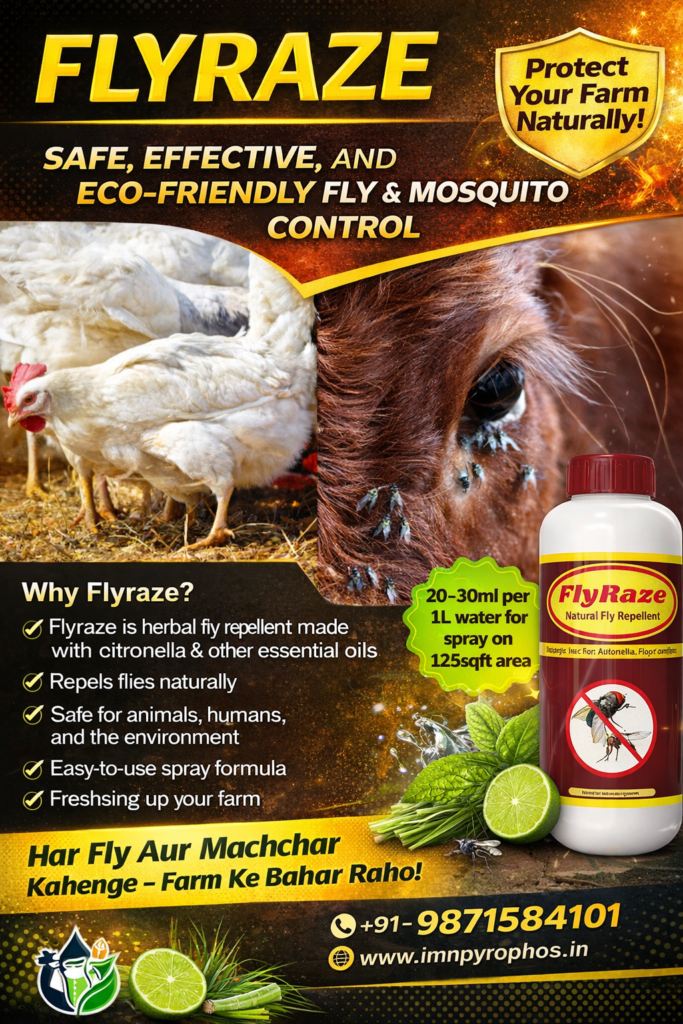
Along with proper management, using a natural product like Flyraze can also help in fly control. Flyraze is a herbal fly repellent made from citronella, which is known for its natural insect-repelling properties. It is safe, eco-friendly, and does not harm birds, workers, or the environment.
Chemical or poison-based treatments can be risky. They may cause resistance in flies, harm useful insects, and can also affect birds, humans, and the environment if not used properly. Because of these risks, chemical control should always be used as a last option.
In comparison, citronella-based products like Flyraze are safer for regular use. Citronella not only repels flies but also helps in reducing their breeding activity. With frequent use, it can significantly reduce the fly population over time and help control the problem in the long term.
https://imnpyrophos.in/ols/products/flyraze-1l—natural-fly-repllent