
Precision Dairy Feed Management: From Transition Physiology to High-Yield Feed Formulation Systems
Modern dairy production is no longer constrained primarily by feed availability; it is constrained by how effectively nutrition aligns with the cow’s metabolic prioritization. Dairy feed management today is fundamentally a problem of biological coordination rather than ingredient selection. Genetic selection for milk yield has shifted nutrient partitioning such that maintenance remains protected, lactation becomes a dominant nutrient sink, and reproduction, immunity, and tissue repair become conditionally supported functions. This reality means that dairy feed formulation cannot be treated as static recipe development — it must function as a dynamic metabolic management system.
Agar simple kahe to: aaj ki dairy feeding ka matlab sirf sahi dana banana nahi hai, balki animal ke metabolism ke sath feeding ko synchronize karna hai — warna nutrients hone ke bawajood performance unstable rahega.
The transition period, particularly the last three weeks pre-calving through early lactation, represents the metabolic hinge on which subsequent production efficiency depends. During this phase, endocrine signals reprogram insulin sensitivity, hepatic gluconeogenesis accelerates, adipose tissue lipolysis becomes permissive, and calcium homeostasis shifts from storage to rapid mobilization. If feed formulation fails to anticipate these systemic shifts — for example by ignoring DCAD balance, rumen osmotic stability, or fiber fermentation kinetics — the consequences typically appear later as ketosis, milk fever, mastitis susceptibility, or reproductive inefficiency rather than as immediate feed refusal.
Isko practical language me samjhein: transition me galti turant nahi dikhti, par peak milk phase me fat drop, repeat breeding ya metabolic stress ke form me saamne aati hai.
Dairy Feed Formulation Is Not Ingredient Math — It Is Fermentation Engineering
The most overlooked aspect of dairy feed formulation is that ruminants do not digest feed in the classical enzymatic sense before absorption; they ferment it microbially. This distinction is not semantic. Fermentation introduces variability driven by rumen osmolarity, microbial population dynamics, passage rate, buffer capacity, carbohydrate fermentability, and nitrogen synchronization.
A conventional dairy feed formula often focuses on crude protein, energy density, and mineral adequacy. However, two rations with identical nutrient percentages may perform very differently depending on rumen microbial capture efficiency. When rapidly fermentable starch exceeds microbial adaptation capacity, osmotic pressure rises, protozoal populations destabilize, fungal fiber degraders decline, and fiber digestibility falls even if dietary fiber levels appear adequate on paper.
rumen me sirf nutrient nahi jaata — microbial ecosystem ko environment milta hai; agar environment unstable hua to best formula bhi fail ho sakta hai.
This is precisely why high-producing herds sometimes exhibit “functional energy deficiency” despite high calculated NEL intake. The limitation lies not in supply but in microbial conversion efficiency and epithelial absorption capacity.
Precision Dairy Feed Formulation: Beyond Static Recipes
The shift from traditional feed formulation toward precision dairy feed management has been accelerated by two developments: availability of forage laboratory analysis and digital formulation tools such as dairy feed formulation Excel sheets and advanced dairy feed formulation calculators.
These tools, when used correctly, do not merely calculate nutrient totals; they allow modeling of rumen degradable protein synchronization, metabolizable protein supply, fermentable carbohydrate fractions, and mineral interactions like DCAD or potassium loading effects from silage. However, the presence of a dairy feed formulation Excel sheet alone does not ensure precision — calibration to field data, ingredient variability, and animal response feedback remains essential.
Aap ise aise samjhein: Excel calculator formula banata hai, lekin biological response samajhna doctor ya consultant ka kaam hota hai.
Precision feeding therefore involves iterative adjustment: analyzing silage nutrient variability, adjusting concentrate density, stabilizing rumen fermentation, and aligning feeding rhythm with intake behavior.
Transition Feeding: Where Most Dairy Feed Management Fails
The biological objective of transition feeding is not production stimulation but physiological adaptation. The cow must simultaneously prepare for calcium outflow, increased glucose demand for lactose synthesis, hepatic fat handling, and rumen microbial adaptation to higher energy diets.
When prepartum diets are excessively energy dense without adequate fiber structure, rumen papillae adaptation lags behind fermentation intensity. Conversely, overly dilute diets suppress intake and compromise hepatic metabolic priming. Either scenario predisposes to postpartum metabolic disorders.
transition feeding ka goal doodh badhana nahi, body ko lactation ke liye taiyar karna hota hai.
Calcium metabolism illustrates survival biology clearly. Neuromuscular function is prioritized over skeletal reserves, and lactation calcium export begins abruptly. If endocrine responsiveness — especially parathyroid hormone signaling — has not been primed through appropriate DCAD manipulation, clinical or subclinical hypocalcemia becomes likely even when dietary calcium appears adequate.
High Milk Production (45–60 L): Constraints Beyond Feed Quantity
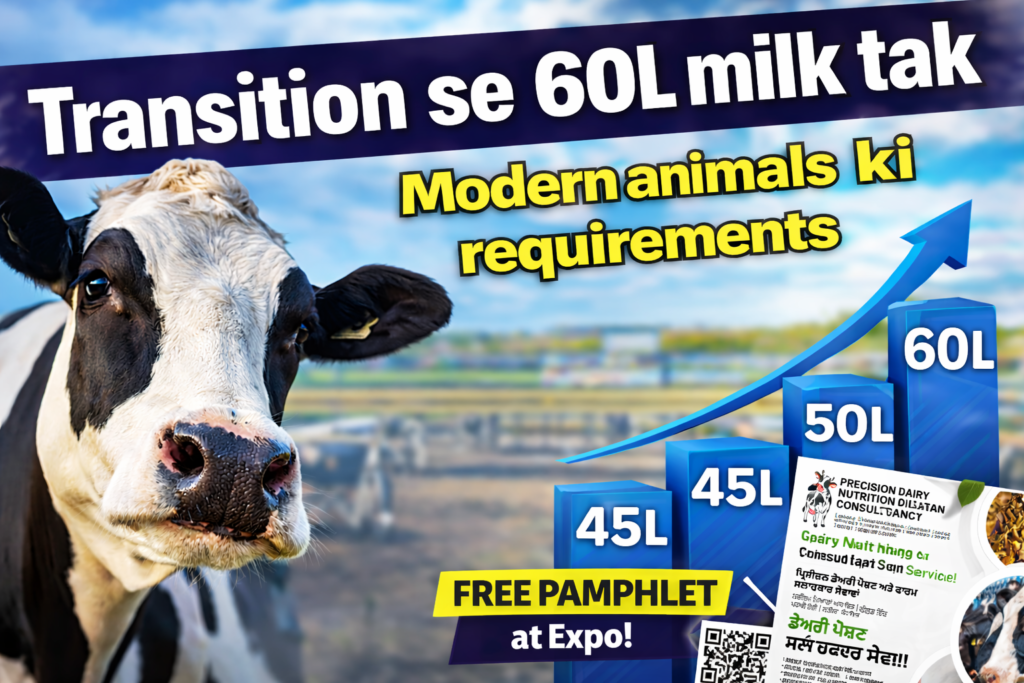
As milk production approaches 50–60 liters per day, intake capacity, rumen microbial efficiency, hepatic oxidative capacity, and endocrine stability become co-limiting factors. Increasing concentrate inclusion alone often produces diminishing returns because fermentation kinetics accelerate faster than rumen epithelium adaptation.
This stage also exposes metabolizable protein limitations. Microbial protein synthesis depends on synchronized carbohydrate fermentation and rumen degradable nitrogen availability. Excess bypass protein without microbial nitrogen sufficiency may reduce fiber digestion, while excessive degradable protein without carbohydrate synchronization increases ammonia load and hepatic urea synthesis energy cost.
zyaada protein dena solution nahi hota; protein kis form me hai aur rumen usko kaise use karega — ye zyada important hota hai.
Reproductive performance frequently declines at high milk yield not solely because of energy deficit but due to endocrine prioritization. Low insulin and IGF-1 signaling delay follicular maturation, while elevated NEFA and ketone bodies impair oocyte quality. Chronic low-grade inflammation originating from rumen instability or hepatic overload further modulates reproductive hormone signaling.
Digital Tools: Dairy Feed Formulation Calculator and Excel Systems
Modern dairy feed formulation increasingly relies on integrated digital systems. A robust dairy feed formulation calculator should ideally incorporate:
- dynamic forage nutrient variability
- rumen fermentation modeling
- metabolizable protein prediction
- mineral interaction balancing
- energy partition modeling
But even the best dairy feed formulation Excel sheet remains an analytical tool, not a decision-maker. Biological interpretation, field observation, and iterative calibration remain essential.
software guidance deta hai, lekin field response hi final decision maker hota hai.
The Real Goal of Dairy Feed Management
Ultimately, effective dairy feed management is about maintaining metabolic stability while supporting production. Production losses rarely occur because nutrients are absent; they occur because physiological coordination fails. Rumen stability, hepatic metabolic capacity, endocrine adaptation, and immune resilience together determine whether a high-producing dairy animal sustains output or enters a cycle of metabolic compromise.
Isliye modern dairy feeding ko sirf ration balancing nahi samajhna chahiye — ye system biology ka practical application hai.
Dairy Farming Training ke Liye is link se app download karein aur online course join karein
Consultancy ke liye sampark karien 9871584101
1. Transition period me sabse bada risk factor kya hota hai?
A) Kam dana khana
B) Hormonal–metabolic adaptation mismatch
C) Sirf calcium deficiency
D) Sirf body condition score
(Correct direction: B — systemic adaptation failure)
2. High-yield modern cows me nutrients sabse pehle kis taraf divert hote hain?
A) Fertility
B) Immunity
C) Milk production
D) Body fat restoration
(Correct: C — lactation priority physiology)
3. Rumen me feed primarily digest hota hai ya ferment?
A) Digest
B) Ferment
C) Half digest half ferment
D) Direct absorb
(Correct: B — microbial fermentation)
4. Ketosis ka main trigger kya zyada hota hai?
A) Sirf kam energy feeding
B) Hepatic fat handling + rumen fermentation mismatch
C) Calcium deficiency
D) Excess fiber
(Correct: B — systems view)
5. High milk production me sabse limiting factor kya ban sakta hai?
A) Feed quantity
B) Rumen microbial efficiency
C) Water intake
D) Salt supplementation
(Correct direction: B — microbial capture efficiency)
6. Precision dairy feeding ka core goal kya hai?
A) Zyada dana khilana
B) Cheapest ration banana
C) Metabolic stability maintain karna
D) Sirf protein badhana
(Correct: C — stability over quantity)
7. Transition feeding ka primary objective kya hona chahiye?
A) Maximum milk push
B) Body weight gain
C) Physiological adaptation
D) Fat percentage increase
(Correct: C)