
Silage Dry Matter: Why Silage Dry Matter Percentage Decides Milk Potential More Than Any Ration Formula
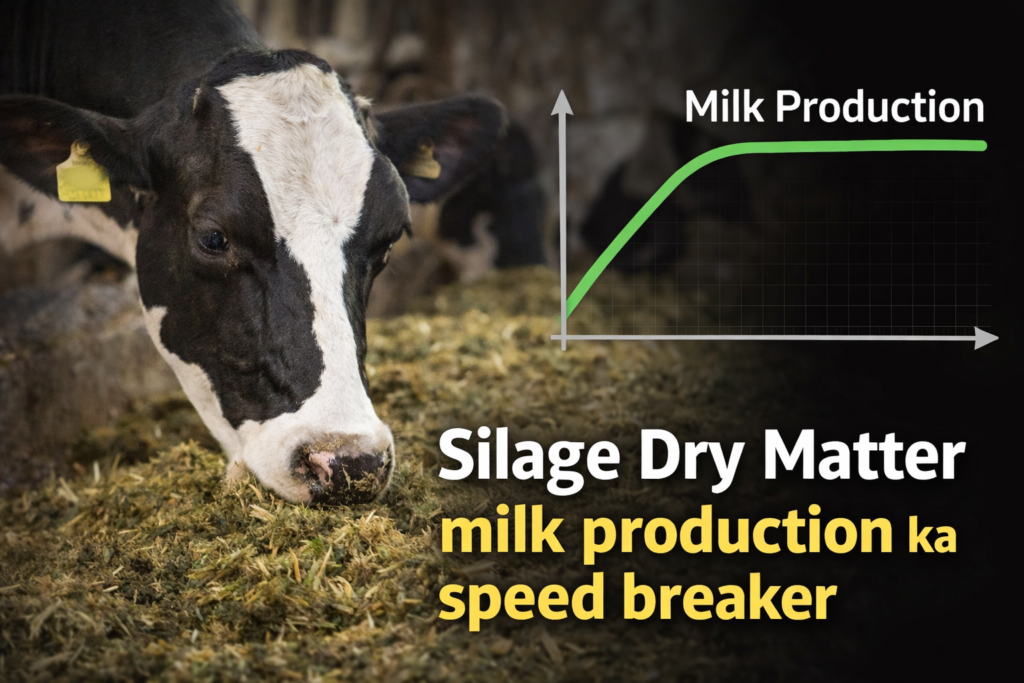
In modern dairy nutrition, silage dry matter is often discussed as a background parameter—something that is measured, recorded, and then quietly absorbed into ration software. Yet on high-performing dairy farms, silage dry matter content is not a passive number. It is a biological constraint that determines whether a cow is limited by rumen volume or by metabolic energy demand.
This distinction explains one of the most common production paradoxes in dairy systems worldwide:
why moving from 30 to 40 liters of milk often feels easy, while moving from 40 to 45 liters feels biologically impossible—despite apparently balanced rations.
To understand this, silage dry matter must be examined not as a feed value, but as a physical determinant of intake capacity.
What Is Silage Dry Matter—Technically, Not Textbook-Wise
Silage dry matter refers to the proportion of a silage that is not water, expressed as a percentage. A silage with 30% dry matter contains 70% water. A silage with 26% dry matter contains 74% water.
At face value, the difference appears small. In reality, the difference between 26% and 32% silage dry matter percentage represents a fundamental shift in rumen mechanics.
From a biological perspective, silage dry matter content determines:
- The amount of water delivered per unit of fermentable substrate
- The degree of fibre hydration and swelling
- The physical bulk of the rumen mat
- The timing at which rumen distension signals suppress intake
Cows do not regulate feed intake by dry matter numbers. They regulate intake through stretch receptors, osmolarity, and rumen fill, with metabolic demand acting only after physical constraints are satisfied.
Why Silage Dry Matter Is a Physical Variable, Not a Nutrient Variable
Most ration models treat silage dry matter as a correction factor—used to calculate dry matter intake, NEL intake, or crude protein supply. This approach misses the central biological truth:
Silage dry matter determines how much space energy occupies in the rumen.
Two rations can deliver identical NEL per day on paper and produce radically different milk responses in reality if silage dry matter content differs.
This is because:
- Water does not contribute energy
- But water profoundly influences rumen volume
- Fibre hydration increases physical occupancy faster than fermentable mass
Thus, low silage dry matter creates energy dilution through volume, not energy deficiency.
Understanding Silage Dry Matter Percentage Through Rumen Physics
Consider a corn silage at 26–27% dry matter:
- For every 1 kg of dry matter consumed, approximately 2.7–3.0 kg of water enters the rumen
- This water binds to NDF
- Fibre swells, thickening the rumen mat
- Rumen fill reaches satiety before metabolic energy demand is met
In contrast, a 31–33% dry matter silage:
- Delivers significantly less water per unit of DM
- Produces less fibre swelling
- Occupies less rumen volume for the same energy intake
The cow consuming higher silage dry matter content reaches metabolic satiety before physical satiety. That distinction defines high milk response.
Why Low Silage Dry Matter Caps Milk Yield Without Obvious Symptoms
One of the most confusing aspects of low silage dry matter systems is that cows often appear perfectly healthy.
Typical observations include:
- Normal cud chewing
- Stable rumen pH
- Normal manure consistency
- No acidosis
- No visible stress
Milk fat and protein may remain within normal ranges. Yet milk yield plateaus.
This occurs because volumetric satiety precedes metabolic satiety.
The cow stops eating not because:
- Energy is sufficient
- Protein is sufficient
- Rumen is unstable
But because:
- The rumen is physically full of hydrated fibre and water
As a result, nutritionists often misdiagnose such herds as:
- Protein-limited
- Energy-adequate but non-responsive
- Genetics-limited
In reality, the cow is space-limited.
Why 30–40 Liters Is Easier Than 40–45 Liters
Between 30 and 40 liters of milk, most cows can increase output through energy densification:
- Adding concentrate
- Improving starch digestibility
- Slightly increasing fat inclusion
At this stage, existing rumen space can still accommodate more energy per unit volume.
However, beyond approximately 38–40 liters:
- Each additional liter of milk requires disproportionate increases in metabolizable energy
- Energy addition now demands additional rumen space
If silage dry matter percentage is low, that space simply does not exist.
This is why:
- Adding protein improves efficiency but not yield
- Fat increases energy density but not intake capacity
- Yeast stabilizes fermentation but does not increase volume reserve
Milk stalls not due to nutrient imbalance, but due to geometric limitation.
The Role of Silage Dry Matter Calculator—And Its Limitations
A silage dry matter calculator is useful for:
- Correcting ration formulation
- Estimating actual dry matter intake
- Preventing over- or under-feeding nutrients
However, calculators do not model rumen physics.
They cannot account for:
- Fibre swelling behavior
- Water-associated rumen occupancy
- Volumetric satiety thresholds
Thus, a silage dry matter calculator may indicate adequate NEL intake while the cow remains physically unable to express that energy as milk.
This explains why ration software often predicts higher milk than what is achieved in practice under low silage dry matter conditions.
Comparing Low vs Normal Silage Dry Matter Systems
Low Silage Dry Matter (25–28%)
- Intake capped by rumen fill
- Energy diluted by water
- Milk response plateaus early
- Nutrient pushing yields diminishing returns
- High risk of misdiagnosis
Normal Silage Dry Matter (30–35%)
- Intake governed by metabolic demand
- Efficient energy expression
- Clear response to concentrate and MP optimization
- Predictable milk response curves
The difference is not nutritional quality—it is physical efficiency.
Why Low Silage Dry Matter Often Looks “Fine” on Paper
Laboratory analysis may show:
- Acceptable NEL
- Adequate crude protein
- Balanced starch and NDF
But lab values measure chemical composition, not physical behavior.
Silage dry matter content determines how those nutrients behave once hydrated inside the rumen. This explains why two silages with identical lab values can perform very differently.
How to Prevent Silage Dry Matter–Related Performance Limits
1. Harvest Management
- Harvest corn silage at optimal kernel maturity
- Avoid excessive moisture at chopping
- Target consistent dry matter, not yield alone
2. Packing and Fermentation Control
- Proper packing density reduces secondary fermentation
- Limits excessive moisture retention
- Preserves structural integrity of fibre
3. Storage and Face Management
- Prevent rainwater ingress
- Avoid seepage losses
- Maintain stable dry matter throughout feed-out
4. Ration Geometry, Not Just Chemistry
- Reduce high-water, low-structural feeds when silage DM is low
- Preserve structural fibre (do not remove straw indiscriminately)
- Use concentrate to replace volume, not add to it
5. Monitor Physical Intake Signals
- Watch intake plateaus, not just DMI numbers
- Observe refusal patterns
- Track milk response to densification, not just formulation changes
The Correct Conceptual Framework
Silage dry matter is not a background number.
It defines whether the cow operates in:
- A volume-limited state, or
- An energy-limited state
Milk yield responds to nutrients only after physical constraints are resolved.
Until silage dry matter percentage allows sufficient rumen space for energy expression, no ration optimization can unlock higher genetic potential.
Final Takeaway
- Silage dry matter content governs rumen physics
- Low silage dry matter percentage dilutes energy through water-mediated fill
- Milk yield plateaus are physical, not nutritional failures
- Silage dry matter calculators assist formulation but do not model biology
- Preventing low silage dry matter issues requires management, not supplementation
Understanding silage dry matter at this level transforms ration formulation from guesswork into predictable biology.