
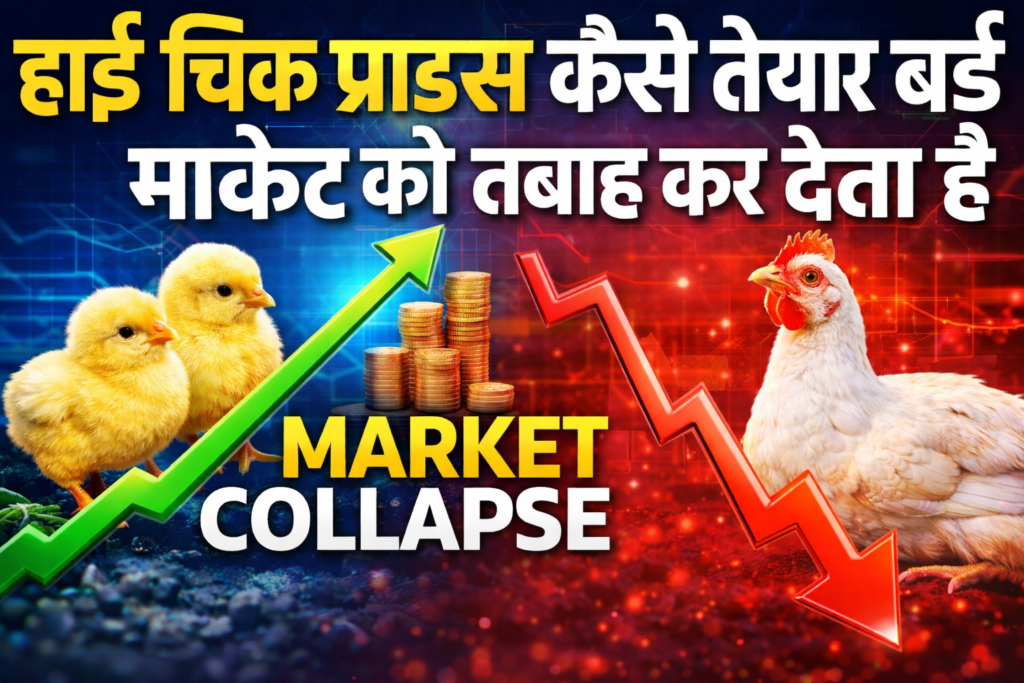
Broiler Market Prediction: Why Rising Chick Prices Often Lead to Market Collapse
An analytical explanation of how rising chicks prices force higher bird weights, increase meat supply, and ultimately cause broiler market collapse. Data-driven insights using a poultry cost and profit calculator.
Introduction: Broiler Market Is Not Random, It Is Cyclical
The Indian broiler market often appears unpredictable to farmers. Prices rise suddenly, chick rates shoot up, confidence returns to the industry, and then—almost inevitably—the market collapses. Many farmers believe this collapse happens due to middlemen, traders, or manipulation, but when we analyze the system scientifically, the reason is far more structural.
Like every other market, the broiler market is governed by a simple economic principle: supply and demand, but with a biological twist. Unlike manufactured goods, broiler meat supply is directly linked to bird biology—growth rate, final live weight, and production decisions made weeks earlier.
Simple shabdon mein bolein to, market aaj nahi girta, market 6–8 hafte pehle liye gaye decisions ka result hota hai.
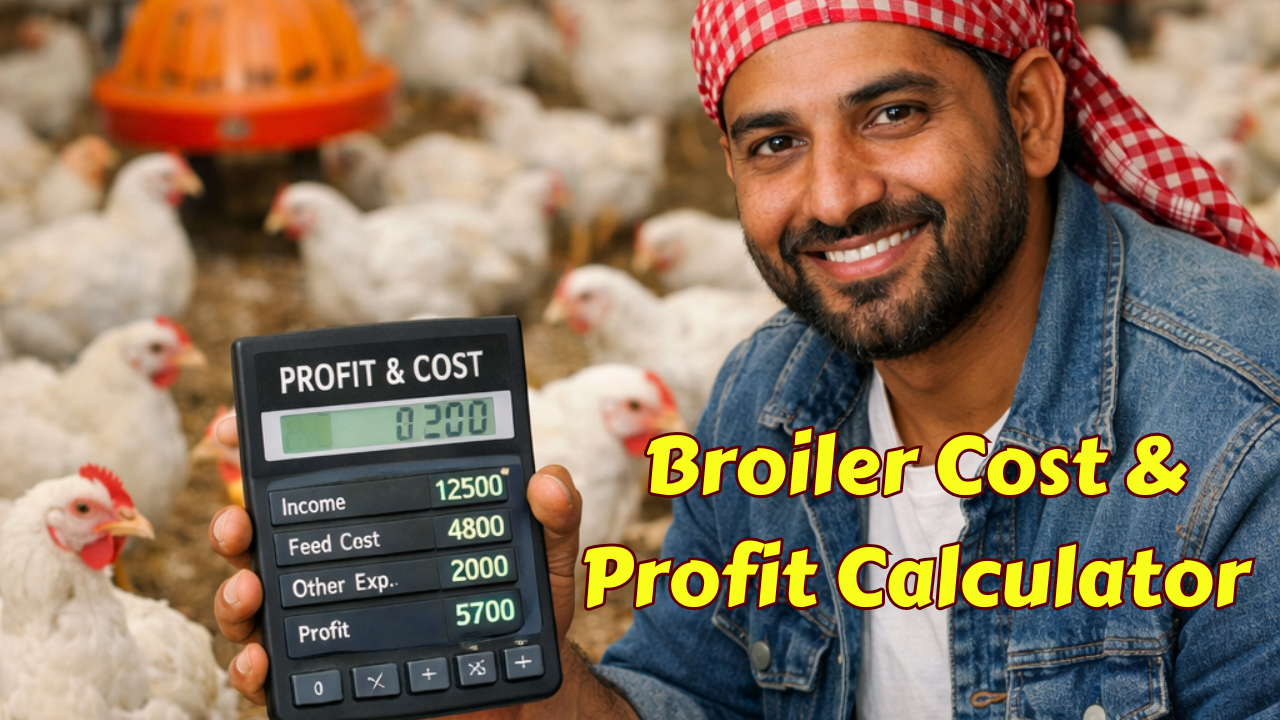
This article explains, step by step, why higher chick prices often sow the seeds of future market collapse, using real production numbers and calculations generated through the Poultry Cost and Profit Calculator available on Ali Veterinary Wisdom.
Understanding the Stable Phase: When Chick Prices Are Low
Let us first understand what happens when chick prices are relatively low, around ₹33 per chick. In such a phase, broiler production remains disciplined. Farmers and integrators are not under pressure to stretch bird performance beyond biological efficiency.
Using the poultry cost and profit calculator, a standard example can be constructed with the following assumptions, which closely resemble real Indian field conditions.
Scenario 1: Chick Price ₹33
| Parameter | Value |
|---|---|
| Number of birds placed | 10,000 |
| Chick cost (₹/bird) | 33 |
| Mortality | 5% |
| Feed cost (₹/kg) | 35 |
| Feed consumption | 3.1 kg |
| FCR | 1.55 |
| Average live weight | 2.0 kg |
| Medicine cost (₹/bird) | 3 |
| Other expenses (₹) | 1,00,000 |
| Market price (₹/kg) | 100 |
Under this scenario, birds are sold at around 2.0 kg live weight. Feed efficiency remains optimal, metabolic stress is low, mortality stays under control, and most importantly, profit per bird remains healthy, approximately ₹35–37 depending on local conditions, like in recent weeks.
This profit margin allows integrators to give incentives to contract farmers, farmers remain satisfied, and there is no aggressive push to increase bird size.
jab profit apne aap nikal raha ho, to kisi ko bird ko zabardasti kheenchne ki zarurat nahi padti.
Now comes the most critical part—market supply discipline.
Why Lower Bird Weight Keeps Market Supply Balanced
Let us assume that consumer demand for broiler meat remains relatively constant through the year. For simplicity, take a demand of 1,00,000 kg (1 lakh kg) meat.
If the average bird weight is 2.0 kg, then the number of birds required to meet this demand will be:
1,00,000 kg ÷ 1.7 kg = 71,500 birds
When birds are marketed at this weight, supply matches demand. Prices remain stable, traders lift birds comfortably, and there is no panic selling.
This is the stable zone of the broiler market.
The Trigger Point: When Chick Prices Rise Sharply
Problems begin when chick prices increase sharply, for example from ₹33 to ₹48 per chick. This rise is usually driven by temporary shortage of chicks, higher breeder profitability expectations, or a recent period of good broiler prices.
From a cost structure perspective, a ₹15 increase in chick price is significant. Farmers and integrators immediately start recalculating their economics.
Here the psychology changes.
Instead of asking, “How efficiently can I produce?”, the question becomes, “How do I recover higher chick cost?”
And the most common answer is: increase bird weight.
High Chick Price Forces Heavier Birds
Using the same calculator and keeping most variables constant, let us examine the high chick price scenario.
Scenario 2: Chick Price ₹48
| Parameter | Value |
|---|---|
| Number of birds placed | 10,000 |
| Chick cost (₹/bird) | 48 |
| Mortality | 5% |
| Feed cost (₹/kg) | 35 |
| Feed consumption | 4.7 kg |
| FCR | 1.75 |
| Average live weight | 2.7 kg |
| Medicine cost (₹/bird) | 3 |
| Other expenses (₹) | 1,00,000 |
| Market price (₹/kg) | 100 |
To maintain profit per bird under this scenario, birds are pushed to 2.7 kg live weight. On paper, this seems logical. The extra 700 grams compensates for higher chick cost.
But biologically and economically, this is where the system starts breaking.
problem bird ke size mein nahi, problem total supply mein hoti hai.
How Heavier Birds Increase Total Meat Supply
Let us revisit the same market demand of 1,00,000 kg meat.
At 2.7 kg live weight (2.7kg bird gives 2.1kg meat), the number of birds required becomes:
1,00,000 kg ÷ 2.1 kg ≈ 47,619 birds (let us take it as 47,500 birds for sake of simplicity)
Compare this with the earlier requirement of 71,500 birds at 2.0 kg.
This means that 24,000 birds become surplus for the same level of consumer demand.
In your slide example, the difference was even more striking:
- 71,500 birds at 2.0 kg
- 49,500 birds at 2.7 kg
- Extra birds entering market = 24,000
These extra birds are not planned intentionally. They are a by-product of every farmer trying to protect individual profitability.
But markets do not respond to individual logic; they respond to aggregate supply.
Integrator-Level Impact: Supply Flooding Happens Quietly
Let us extend this logic to integrators.
Assume there are 5 major integrators operating in a region.
When each integrator markets around 19,000 kg meat, total supply is:
5 × 19,000 = 95,000 kg
Demand and supply remain aligned.
But when higher chick prices force each integrator to push birds heavier, production may rise to 25,000 kg per integrator.
Now total supply becomes:
5 × 25,000 = 1,25,000 kg
This is 30% more meat than market demand.
kisi ek integrator ko lagta hai usne sahi decision liya, lekin jab sab same decision lete hain, to market gir jaata hai.
This is the exact point where market collapse begins, not because demand fell, but because supply silently expanded.
Why Market Collapse Feels Sudden but Is Actually Predictable
From the farmer’s perspective, market collapse feels abrupt. Prices fall within days. Birds stop lifting. Traders delay payments.
But biologically, the collapse was locked in weeks earlier, when higher chick prices forced heavier bird targets.
Broiler production has a biological lag. Decisions taken at placement reflect in the market 35–45 days later. That is why chick prices today often predict broiler prices two months ahead.
jab chicks mehngay hote hain, tabhi market girne ka beej pad jaata hai.
Why the Industry Ends at the Same Profit Level
A very important observation from is that, ultimately, total money available in the industry does not change significantly. Whether chick prices are low or high, the industry tends to redistribute profits internally.
When chicks are cheap:
- Farmers earn
- Integrators earn
- Market remains stable
When chicks are expensive:
- Farmers stretch birds
- Supply increases
- Market crashes
- Profit evaporates through price reduction
In the end, sabko lagta hai zyada kama rahe hain, lekin industry ka dam wahi ka wahi rehta hai.
Using Calculation Tools to Predict the Market
This is where analytical tools become essential. The Poultry Cost and Profit Calculator allows producers to simulate scenarios before making biological decisions.
Instead of asking, “Kitna weight badha sakte hain?”, the right question becomes, “Is weight increase industry-wide supply ko kitna badha dega?”
This shift in thinking separates reactive producers from strategic producers.
You can access the calculator here:
👉 https://aliveterinarywisdom.com/poultry-cost-profit-calculator/
Watch the Full Explanation
Below is the detailed video where this entire logic is explained step by step using real numbers and live calculations.
Conclusion: Chick Prices Are a Signal, Not Just a Cost
High chick prices are not merely a cost challenge; they are a market signal. They indicate that the next production cycle requires discipline, not aggression.
The broiler market does not collapse because farmers make mistakes individually. It collapses because everyone responds rationally in isolation, but irrationally as a group.
The producers who survive long term are not those who chase maximum bird weight, but those who understand market biology, supply cycles, and economic feedback loops.
market ko jeetne ke liye bird ko nahi, system ko samajhna padta hai.