
Indian Buffalo Breeds Explained: Murrah and Other Major Breeds from a Livestock Consultant’s Lens
Introduction: Breed Selection Is Not a Fashion Choice

One of the most common questions asked by dairy farmers across India is deceptively simple:
“Doctor, kaunsi buffalo sabse achhi hai?”
This question reflects a deep misunderstanding of how breed, biology, and farm systems interact. There is no universally “best” buffalo breed. What exists instead is a best fit between breed potential and farm capability.
Breed koi magic solution nahi hoti.
Breed sirf potential deti hai — performance system deta hai.
Over years of veterinary consultancy, it becomes clear that many buffalo-related disappointments begin at the breed selection stage, not because farmers choose the wrong animal, but because they choose animals without understanding what that breed biologically demands.
What a “Breed” Actually Means in Dairy Buffalo Farming
In veterinary and animal science terms, a breed is not just an external appearance or a regional name. A breed represents a genetically stabilised biological package that influences:
- Milk yield potential and persistency
- Fat and SNF trends
- Body size and maintenance energy requirement
- Heat tolerance and stress sensitivity
- Reproductive rhythm and fertility resilience
Each buffalo breed has evolved under specific environmental and feeding conditions. When a breed is moved outside that comfort zone, performance depends entirely on how well management compensates for the change.
Yahin par science aur field reality milti hai.
Why Murrah Became India’s Most Popular Dairy Buffalo
Murrah buffalo did not become popular by chance. Its dominance in Indian dairy farming is rooted in a rare combination of traits that suit commercial milk production:
- High milk yield potential
- Consistently good fat percentage
- Compact yet strong body structure
- Adaptability to stall-fed and semi-intensive systems
Under organised or semi-organised management, Murrah buffaloes can show excellent lactation persistency and economic returns. This is why Murrah genetics are widely used even beyond their native tract.
However, popularity often hides an uncomfortable truth.
Murrah buffalo sabse zyada popular hai —
aur sabse zyada underperform bhi wahi karti ha
Murrah Buffalo: Strength Lies in Precision, Not Forgiveness
Murrah buffalo is often described as a “high-performance breed.” This description is accurate, but incomplete. High performance always comes with high sensitivity.
Murrah buffaloes respond quickly to:
- Nutritional imbalance
- Mineral deficiency
- Rumen instability
- Heat and metabolic stress
In well-managed farms, this sensitivity becomes an advantage — milk responds positively, fertility stabilises, and overall efficiency improves. In poorly managed systems, the same sensitivity exposes problems rapidly.
Murrah galtiyon ko maaf nahi karti.
Wo unhe amplify kar deti hai.
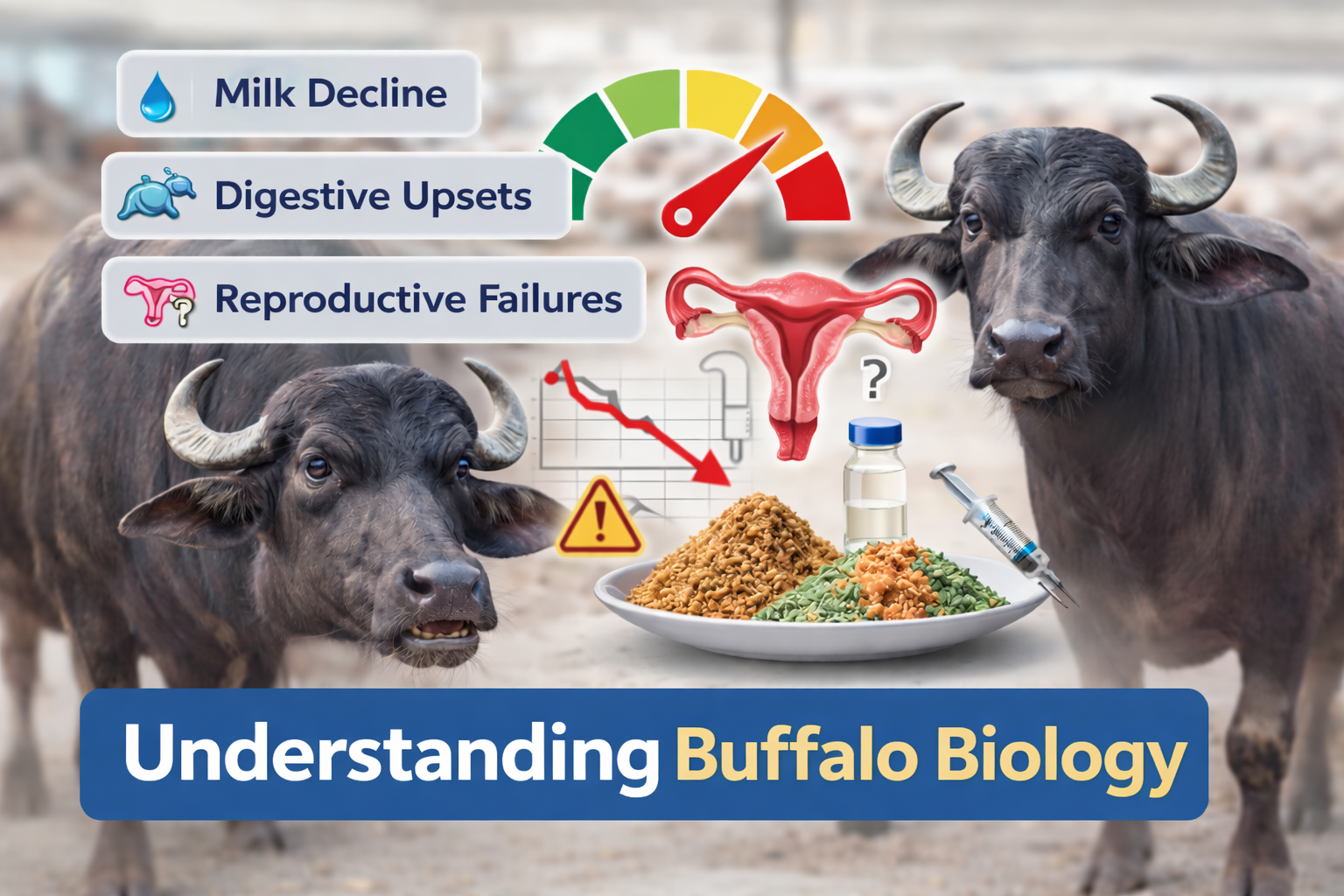
This is why farmers often report that Murrah buffaloes perform very well initially and then decline after a few months. The decline is rarely genetic failure. It is a system mismatch.
Understanding Murrah Through Field Observation
From a consultant’s point of view, Murrah buffaloes give clear early signals when management begins to drift:
- Slight drop in appetite before milk declines
- Subtle fat percentage fluctuation
- Delay or weakening of heat signs
- Increased sensitivity to feed changes
These signals are often ignored because they do not look like “disease.” By the time obvious problems appear, metabolic stress has already accumulated.
Murrah bolti nahi — par hint deti hai.
Nili-Ravi: Often Compared, Rarely Understood
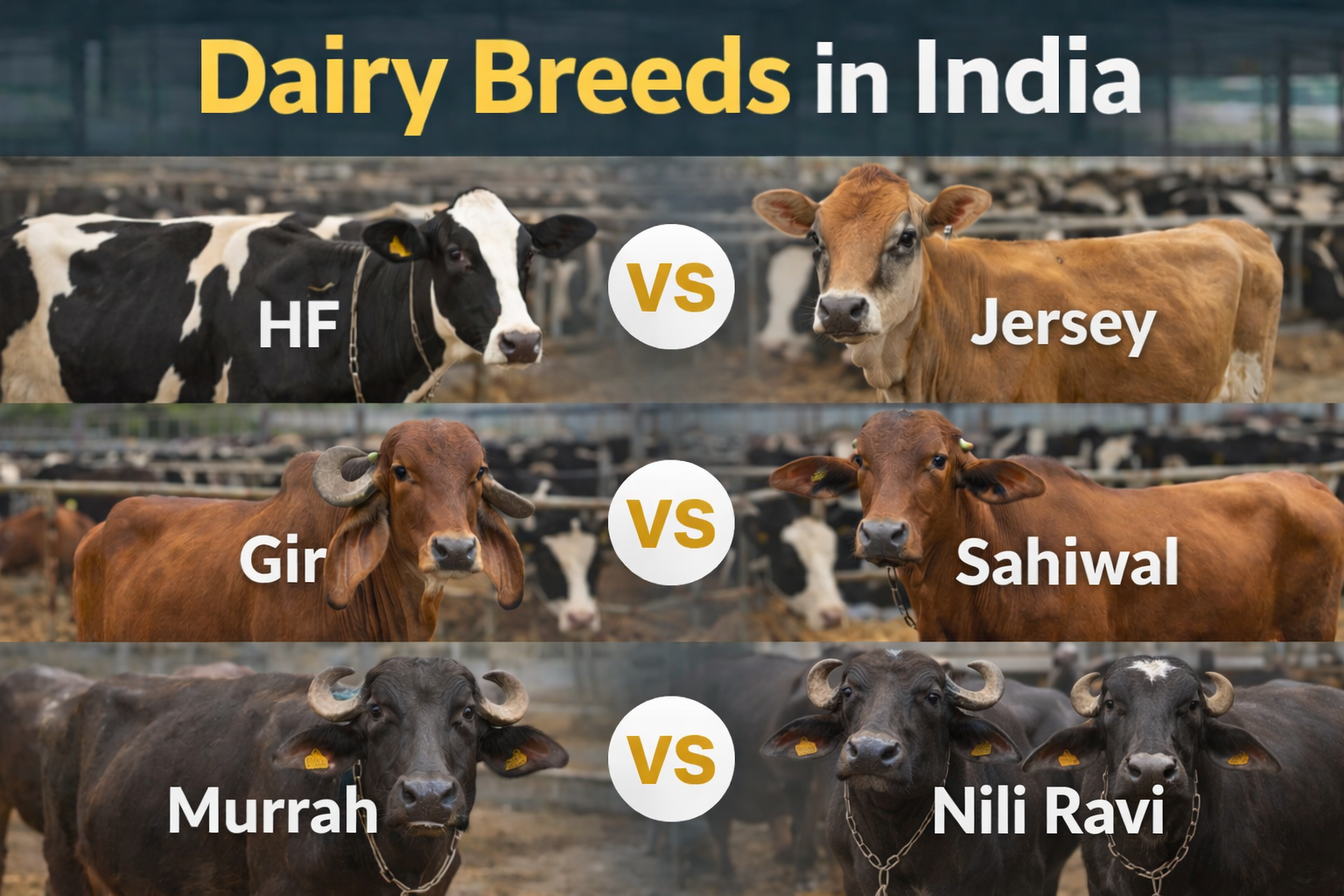
Nili-Ravi buffalo is frequently compared with Murrah, and rightly so. Both are elite dairy breeds with similar milk yield potential. However, their management responses differ subtly.
Nili-Ravi buffaloes often show:
- Slightly better tolerance to certain climatic stresses
- Strong milk persistency when management is stable
- Different udder and teat conformation patterns
In farms where feeding rhythm and housing are consistent, Nili-Ravi can match Murrah performance closely. Where inconsistency exists, both breeds suffer — but Murrah shows problems earlier.
Isliye comparison breed ka nahi, system ka hona chahiye.
Jaffarabadi: Power Comes With Responsibility
Jaffarabadi buffalo is among the largest Indian buffalo breeds. Its sheer body size and strength often attract farmers who associate size with productivity.
This assumption is partially true — Jaffarabadi has strong milk and fat potential. But large body size also means:
- Higher maintenance energy requirement
- Greater metabolic load
- Stronger dependence on consistent roughage quality
Badi body sirf zyada milk nahi maangti.
Wo zyada discipline bhi maangti hai.
In farms where feed quality fluctuates or ration planning is casual, Jaffarabadi buffaloes struggle. In well-prepared systems, they reward the farmer generously.
Surti: Stability Over Aggression
Surti buffalo represents a different philosophy of dairy farming. It is not designed for aggressive milk peaks but for stable, efficient performance.
Surti buffaloes are known for:
- Calm temperament
- Good fat percentage
- Efficient roughage utilisation
In farms where labour skills are moderate and feeding is largely roughage-based, Surti performs reliably. Farmers expecting Murrah-like peaks from Surti often feel disappointed — unfairly so.
Har breed ka kaam alag hota hai.
Bhadawari: When Fat Matters More Than Litres
Bhadawari buffalo occupies a unique place in Indian dairy economics. It is famous not for milk volume, but for exceptionally high fat content.
This makes Bhadawari valuable in:
- Ghee production
- Traditional dairy processing
- Niche high-fat milk markets
However, Bhadawari buffaloes are often mismanaged when farmers push them for higher volume. The breed responds better to fat-focused strategies, not litre-focused pressure.
Yahan quality ka game chalta hai, quantity ka nahi.
Mehsana and Pandharpuri: Balanced and Regional Performers
Mehsana buffaloes are widely used in cooperative dairy systems. They offer balanced milk yield, reasonable fat percentage, and good adaptability. Their performance depends heavily on consistency rather than intensity.
Pandharpuri buffaloes, identifiable by their long horns, represent hardy regional genetics. They perform reliably under low-to-moderate input systems and are often preferred where resilience matters more than peak yield.
Ye breeds flashy nahi hoti — dependable hoti hain.
Banni Buffalo: Survival as a Genetic Strength
Banni buffaloes, native to harsh environments, showcase one of the most underrated traits in dairy farming: survivability.
They tolerate:
- Heat stress
- Feed scarcity
- Environmental fluctuations
While their milk yield may not match elite dairy breeds, their ability to sustain production under stress makes them invaluable in specific regions.
Survival bhi ek production trait hai — bas log usey measure nahi karte.
Consultant Insight: Breed Problems Are Often Expectation Problems
A significant number of breed-related complaints arise not from the animal, but from misaligned expectations.
Farmers expect:
- High milk without system upgrade
- High fat without metabolic support
- Strong fertility under stress
When expectations ignore biology, disappointment is inevitable.
Breed ko blame karna aasan hai.
System ko sudharna mushkil — par profitable hai.
Contact for consultancy 9871584101