
Buffalo Farming in India: Understanding Problems Before Chasing Solutions
(A Veterinary Consultant’s Perspective)
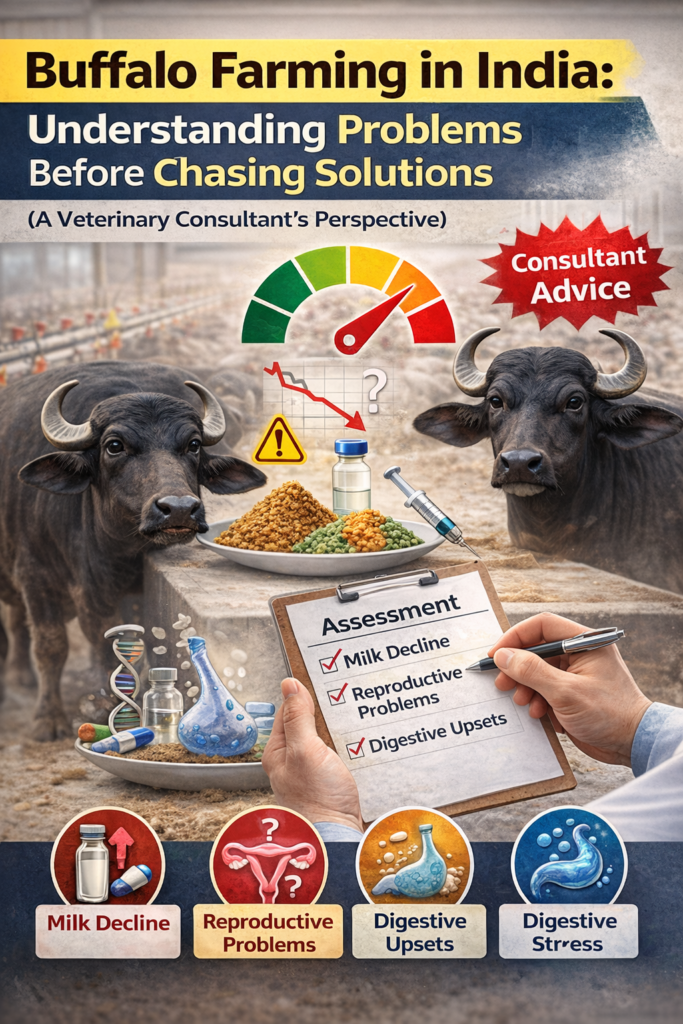
Introduction: Why Most Buffalo Farms Struggle Despite High Potential
Buffalo farming in India carries a paradox that every experienced veterinarian eventually notices. On one hand, buffaloes contribute a significant share to national milk production, provide high-fat milk valued in traditional dairy markets, and adapt well to diverse climatic zones. On the other hand, a large number of buffalo farmers continue to struggle with inconsistent milk yield, poor reproductive performance, and rising veterinary costs.
Sawal ye nahi hai ki potential kam hai.
Sawal ye hai ki potential ka use kyun nahi ho raha.
Over the past decade of continuous online veterinary consultations and close interaction with dairy farmers across different regions, one recurring pattern has emerged: most buffalo farming problems are approached too late and understood too shallowly. Farmers usually react when visible losses occur—when milk drops, conception fails, or disease appears. By that stage, the problem has already travelled a long biological journey inside the animal.
Buffalo farming is not a series of isolated events.
It is a biological system operating continuously, whether we observe it or not.
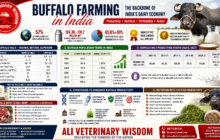
The Role of Buffalo Farming in the Indian Dairy Economy
India’s position as the world’s leading milk producer is strongly supported by buffaloes. In many regions, buffalo milk is preferred over cow milk due to its higher fat content, better heat stability, and superior suitability for products like ghee, paneer, khoa, and traditional sweets.
From an economic standpoint, buffalo farming offers:
- Better price realization per litre due to fat percentage
- Higher resilience under roughage-based feeding systems
- Strong integration with small and marginal farming households
Yet, despite these advantages, productivity per animal remains far below genetic potential on most farms.
Yahan par ek important baat samajhne wali hai:
Low productivity does not always mean poor animals. In most cases, it indicates system inefficiency.
Buffalo Farming Is a Biological System, Not a Routine Activity
One of the biggest misconceptions in buffalo farming is treating it as a routine task. Feeding, milking, and cleaning are performed mechanically, often without understanding how today’s decisions affect the animal weeks or months later.
Buffalo physiology operates on biological momentum.
Nutritional imbalances, stress, or metabolic overload do not cause immediate breakdown. Instead, they slowly alter internal balance until performance begins to decline.
Buffalo shor nahi machati.
Wo signal deti hai — par dheere.
By the time symptoms become obvious, the system has already shifted away from optimal function.
Understanding Buffalo Biology (Without Making It Complicated)
Buffaloes differ from cattle in several important physiological aspects. These differences explain why management strategies copied from dairy cows often fail in buffalo herds.
Key biological characteristics of buffaloes:
- Higher efficiency in utilizing fibrous roughages
- Slower metabolic rhythm compared to high-yielding cows
- Greater sensitivity to mineral and energy imbalance during production stress
- Different heat stress response patterns
In practical terms, this means buffaloes can perform well under low-input systems, but once milk production pressure increases, precision becomes non-negotiable.
Simple shabdon me:
Low input me buffalo adjust kar leti hai,
High output me discipline maangti hai.
Why Problems in Buffalo Farming Rarely Appear Suddenly
One of the most common statements heard during consultations is:
“Doctor, sab theek chal raha tha, achanak problem aa gayi.”
In reality, problems in buffalo farming rarely start suddenly. They develop silently over time through:
- Gradual decline in rumen efficiency
- Accumulation of metabolic stress
- Subclinical mineral deficiencies
- Repeated minor management errors
Milk yield decline, fertility failure, or health breakdown is usually the final visible stage of a long invisible process.
Jo dikhta hai, wo cause nahi hota — wo result hota hai.
Gradual Milk Yield Decline: A System Warning, Not a Feed Problem
Gradual milk decline is one of the most misunderstood issues in buffalo farming. Farmers often respond by increasing concentrate quantity, changing feed brands, or adding random supplements. While these measures may give temporary improvement, they rarely solve the core issue.
Milk production depends on:
- Rumen fermentation efficiency
- Energy balance
- Hormonal stability
- Mineral availability
When any of these components is compromised over time, milk yield slowly declines.
Milk ka girna punishment nahi hota.
Ye system ka warning signal hota hai.
Ignoring this signal and chasing quick fixes often worsens the situation.
Reproductive Problems: When the System Says “Not Now”
Poor reproductive performance in buffaloes—silent heat, repeat breeding, delayed conception—is often treated as a reproductive disorder. However, in most cases, it is a metabolic decision made by the animal’s body.
Reproduction requires surplus energy and metabolic stability. When the system is under stress, the animal prioritizes survival and production over reproduction.
Jab system pressure me hota hai, pregnancy wait par chali jaati hai.
This is why:
- Hormonal treatments alone often fail
- Repeated inseminations do not improve conception
- Animals appear healthy but do not cycle properly
Understanding this shift in priority is crucial for sustainable reproductive management.
Digestive Disturbances: The Hidden Cost of Rumen Instability
Digestive issues in buffaloes rarely appear as dramatic illness. Instead, they show up subtly as:
- Reduced appetite
- Loose or inconsistent dung
- Fluctuating milk fat
- Reduced feed efficiency
Most of these signs point toward rumen imbalance, not feed quantity shortage.
Sudden ration changes, poor fiber structure, inconsistent feeding timing, and unbalanced concentrate ratios disturb the rumen microbial ecosystem. Once this ecosystem is disturbed, even high-quality feed fails to deliver expected results.
Rumen ko sirf bharna kaafi nahi hota.
Rumen ko stable rakhna padta hai.
Why Random Solutions Create Repeating Problems
A common pattern on struggling buffalo farms is the use of multiple uncoordinated interventions:
- One supplement for milk
- Another for fertility
- Another for digestion
Each intervention targets a symptom, not the system. As a result, problems disappear briefly and then return in a different form.
Buffalo farming problems are multi-factorial. They cannot be solved by isolated actions.
Consultancy ka role yahin se start hota hai — symptom se nahi, system se.
Consultant Insight: Why Understanding Must Come Before Action
In professional veterinary consultancy, the goal is not immediate prescription. The goal is interpretation.
Before suggesting any intervention, a consultant tries to understand:
- What exactly is changing on the farm
- How long the change has been occurring
- Which system component is under stress
This approach prevents unnecessary expenses and reduces trial-and-error losses.
Jab farmer ko “kyun” samajh aa jaata hai,
tab “kaise” ka rasta khud banne lagta hai.