
How to Make Mineral Mixture for Cows, Buffaloes, Goats and Other Livestock at Home
A Practical, Cost-Effective Guide for Indian Farmers
Prepared by Ali Veterinary Wisdom
Mineral mixture is one of the most misunderstood yet most critical components of livestock nutrition. Although minerals are required in very small quantities, their role in animal health, production, reproduction and immunity is as important as energy or protein in the diet.
Most farmers routinely use commercial mineral mixtures without understanding what minerals their animals actually need, how much is required, or whether the product they are using is even economical. This article explains how to make mineral mixture at home for cows, buffaloes, goats and other livestock in a scientific yet practical way, suitable for Indian conditions.
Why Mineral Mixture Is Essential in Livestock Nutrition
Livestock and poultry require minerals for:
- Bone development
- Milk production
- Growth and reproduction
- Enzyme and hormone function
- Immunity and disease resistance
Even though minerals are needed in milligram quantities, deficiency leads to major production losses, infertility, weak calves/kids, poor milk yield and metabolic disorders.
Farmers usually provide minerals through premixed mineral mixtures, which are added either:
- Directly into compounded feed
- Or as top dressing over concentrate
The Indian Mineral Mixture Market – Reality Check
In India, the mineral mixture market is extremely large, with hundreds of brands available. Most products differ in:
- Mineral composition
- Inclusion rate
- Price
- Quality of raw materials
Minerals are broadly classified into:
- Macro minerals (Calcium, Phosphorus, Magnesium, etc.)
- Micro or trace minerals (Zinc, Copper, Manganese, Iron, Iodine, Selenium, Cobalt)
Among macro minerals, Calcium and Phosphorus are most important. Among trace minerals, usually six minerals are considered critical from a supplementation point of view.
Why Homemade Mineral Mixture Makes Sense in India
It is generally advisable to buy vitamin premixes and mineral premixes separately, because:
- Certain minerals destroy vitamins when stored together
- Vitamins are unstable and require special handling
If trace mineral premix is purchased as individual salts, home mixing becomes economical, especially when:
- Large quantities of feed are mixed
- Labour cost is low
Both conditions are true in India.
A properly designed self-made mineral mixture can reduce mineral cost by up to 70%, which is highly beneficial for organized dairy and goat farmers who spend heavily on commercial mineral mixtures.
Equipment Required for Making Mineral Mixture at Home
The equipment can be:
- A computerized micro-batch mixer (large farms)
- Or a simple hand-weighing and mixing system (small farms)
The key requirement is accurate weighing and thorough mixing.
Basic Guidelines for Homemade Mineral Mixture
1. Reliable Supply of Mineral Salts
Animals need minerals as elements, but minerals are available as salts. These salts can be purchased from:
- IndiaMART
- Amazon
- Chemical suppliers
Lab-grade salts can also be used.
The availability and cost of pure element in the salt should guide selection. For example, iron content in ferrous sulphate determines its cost effectiveness, not just the price of the salt itself.
2. Know the Required Inclusion Levels
The most important rule in mineral mixture formulation is:
Always think in terms of “mg per kg diet”, not “grams per animal”.
Examples:
- A layer bird eating 100 g feed/day requires about 2.28 mg copper/day, which equals 22.8 mg copper per kg diet
- A 300 kg heifer eating 6 kg dry matter requires 60 mg copper/day, equal to 10 mg copper per kg diet
- A 650 kg cow eating 20 kg DM also requires about 10 mg copper per kg diet
This is why mineral recommendations are always given per kg of diet, not per animal.
3. Feeding Method Matters
- In poultry, minerals must be mixed into the feed (top dressing may cause toxicity)
- In cattle and buffaloes, mineral mixture is commonly given as top dressing
Do not worry about daily requirement calculations. Follow recommended inclusion per kg diet, and mineral mixture formulation becomes simple.
Choosing Inclusion Rate for Premix
A single inclusion rate can be used for all diets, using an intermediate value.
- Low inclusion rate → finishing animals
- High inclusion rate → young or high-producing animals
How to Calculate Mineral Salt Quantity (Example)
Suppose:
- Zinc requirement = 70 mg per kg diet
- Inclusion rate of premix = 2 kg per MT feed
- Zinc source = Zinc oxide (80.3% zinc)
Calculation: (70÷2)×1000÷0.803=43.59g zinc oxide per kg mineral mixture
That means:
- 4.359 kg zinc oxide per 100 kg mineral mixture
- From this, 2 kg premix is added per ton of feed
Mineral Mixture as Top Dressing (Indian Practice)
A 400 kg cow or buffalo eats about 5 kg concentrate/day.
If:
- 2 kg mineral mixture is mixed per 1000 kg feed
- Then 1 kg feed contains 2 g mineral mixture
So:
- 5 kg feed → 10 g mineral mixture/day
Typical top dressing dose:
- 8–13 g per animal, depending on body weight and production
Small excesses are safe, but deficiencies must be avoided.
Carrier Material and Mixing
Use a suitable carrier such as:
- Corn gluten
- Wheat dalia
- Wheat bran
- DORB
Prepare at least 100 kg premix at one time, using a dedicated mixer (never the regular feed mixer). Poor mixing can cause toxicity due to uneven mineral distribution.
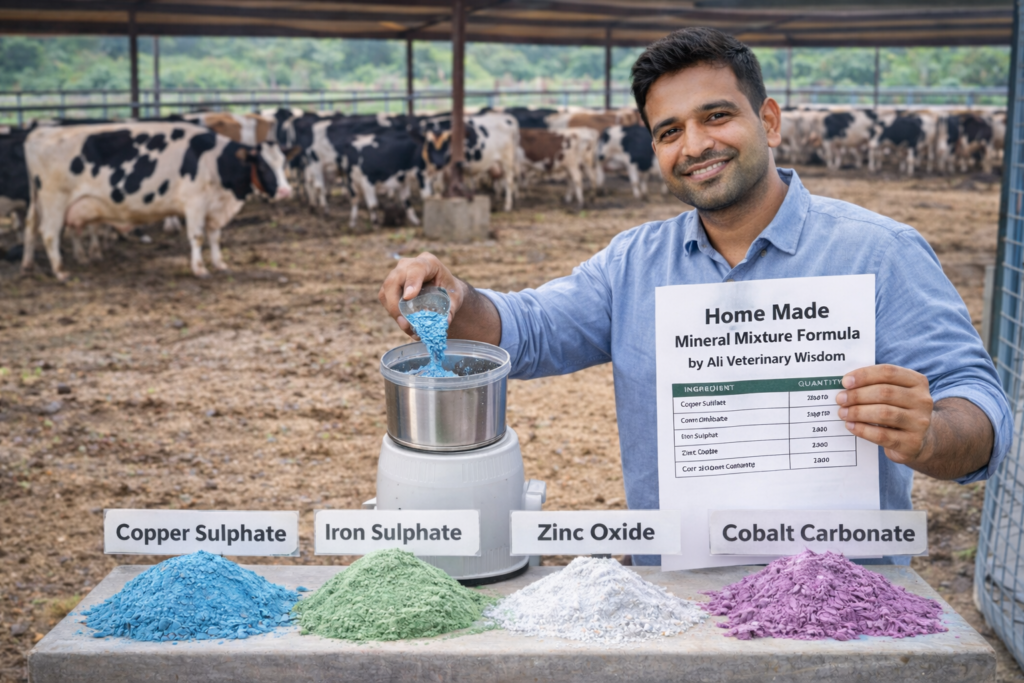
Typical Mineral Mixture Composition (100 kg)
- Zinc Oxide – 3.73 kg
- Ferrous Sulphate – 17.41 kg
- Manganese Sulphate – 6.6 kg
- Copper Sulphate – 2 kg
- Potassium Iodate – 28.9 g
- Sodium Selenite – 32.8 g
- Cobalt Carbonate – 106 g
- DORB – balance to 100 kg
Approximate cost: ₹40 per kg
Daily dose: 5–10 g per animal
Cost per dose: ₹0.20–0.40
Commercial mineral mixture:
- ₹150–180 per kg
- Dose 50 g
- Cost per dose ≈ ₹9
Technical Analysis of Market Mineral Mixtures
Most commercial mineral mixtures contain:
- Vitamins A, D3, E (low-cost contribution)
- Trace minerals in moderate amounts
- High calcium and phosphorus content
At 50 g dose:
- Calcium supplied ≈ 12.5 g, which is insufficient for lactating animals
- Phosphorus often inadequate for production animals
This highlights why blind mineral feeding is inefficient.
Mineral Availability and Bioavailability – Practical Reality
While bioavailability matters, most farmers:
- Do not know mineral requirement
- Do not read mineral composition
- Use lump-sum dosing
In such situations, cost-effective inorganic salts with safety margins are more practical than expensive chelated minerals.
Example comparison for copper clearly shows:
- Chelated minerals are 3–5 times costlier
- Functional performance inside the body is similar
- Cost per available mg mineral is much lower for inorganic salts
Organic vs Inorganic Minerals
Some organic minerals are more bioavailable, but:
- Not all inorganic salts are poorly available
- Cost per unit available mineral is usually higher for organic sources
Organic minerals may be used selectively, but cannot justify blanket replacement in Indian farming systems.
Density and Inclusion Rates Matter
Premix quality depends on:
- Inclusion rate
- Final addition per kg diet
Typical inclusion:
- 2 kg per MT (common)
- 1–2 kg for finishing diets
- 4–5 kg for starter or breeder diets
Home-mixed premixes allow flexibility without increasing cost.
Vitamins – Why They Should Not Be Mixed at Home
Individual vitamin mixing is not recommended because:
- Vitamins are unstable
- Require special storage
- Are expensive and capital intensive
Vitamins should be purchased as ready-made premix from reliable suppliers and never mixed with minerals, as minerals destroy vitamins through chemical reactions.
Final Takeaway
Making mineral mixture at home for cows, buffaloes, goats and other livestock is scientifically sound, economically smart and practically feasible under Indian conditions — provided formulation, weighing and mixing are done correctly.
Understanding what minerals are needed, in what quantity, and at what cost is far more important than blindly feeding expensive branded mineral mixtures.
How to make Mineral Mixture for Cows, Buffaloes & Goats
A properly designed self-made mineral mixture can reduce mineral cost by up to 70%, which is highly beneficial for organized dairy and goat farmers who spend
मिनरल मिक्सचर पशुओं के पोषण का एक बहुत ही ज़रूरी लेकिन अक्सर गलत समझा जाने वाला हिस्सा है। भले ही खनिज तत्व बहुत कम मात्रा में चाहिए होते हैं, लेकिन इनकी कमी से दूध उत्पादन, प्रजनन क्षमता, रोग प्रतिरोधक शक्ति और पशु की समग्र सेहत पर गहरा असर पड़ता है। भारत में अधिकतर किसान बाज़ार में मिलने वाले मिनरल मिक्सचर बिना उसकी संरचना और वास्तविक आवश्यकता को समझे इस्तेमाल करते हैं, जिससे खर्च तो बढ़ता है लेकिन फायदा पूरा नहीं मिल पाता।
इस लेख में बताया गया है कि गाय, भैंस, बकरी और अन्य पशुओं के लिए घर पर मिनरल मिक्सचर कैसे बनाया जा सकता है। यदि सही खनिज लवण (salts) चुने जाएँ, सही मात्रा में मिलाया जाए और ठीक से मिक्सिंग की जाए, तो घर पर बना मिनरल मिक्सचर बाज़ार के उत्पादों की तुलना में 60–70% तक सस्ता पड़ सकता है। लेख में यह भी समझाया गया है कि मिनरल की जरूरत हमेशा “प्रति किलो आहार” के आधार पर तय की जाती है, न कि एक तय मात्रा पशु को देने से।
यह भी स्पष्ट किया गया है कि विटामिन और मिनरल को एक साथ मिलाना सही नहीं होता क्योंकि खनिज विटामिन को नष्ट कर सकते हैं। इसलिए विटामिन प्रीमिक्स हमेशा अलग से देने चाहिए। लेख में chelated और non-chelated minerals की लागत और उपयोगिता की तुलना करके बताया गया है कि भारतीय परिस्थितियों में साधारण इनऑर्गेनिक मिनरल अधिक व्यावहारिक और किफायती होते हैं।
कुल मिलाकर यह लेख किसानों को यह समझने में मदद करता है कि सही जानकारी और थोड़ी सावधानी से वे अपने पशुओं के लिए घर पर प्रभावी, सुरक्षित और कम लागत वाला मिनरल मिक्सचर तैयार कर सकते हैं।